จำนวน Repository ( 3611 )
The diversity of species and utilization of plants at the baan tah tongdeang community forest, nabot ,wangchao district, tak province
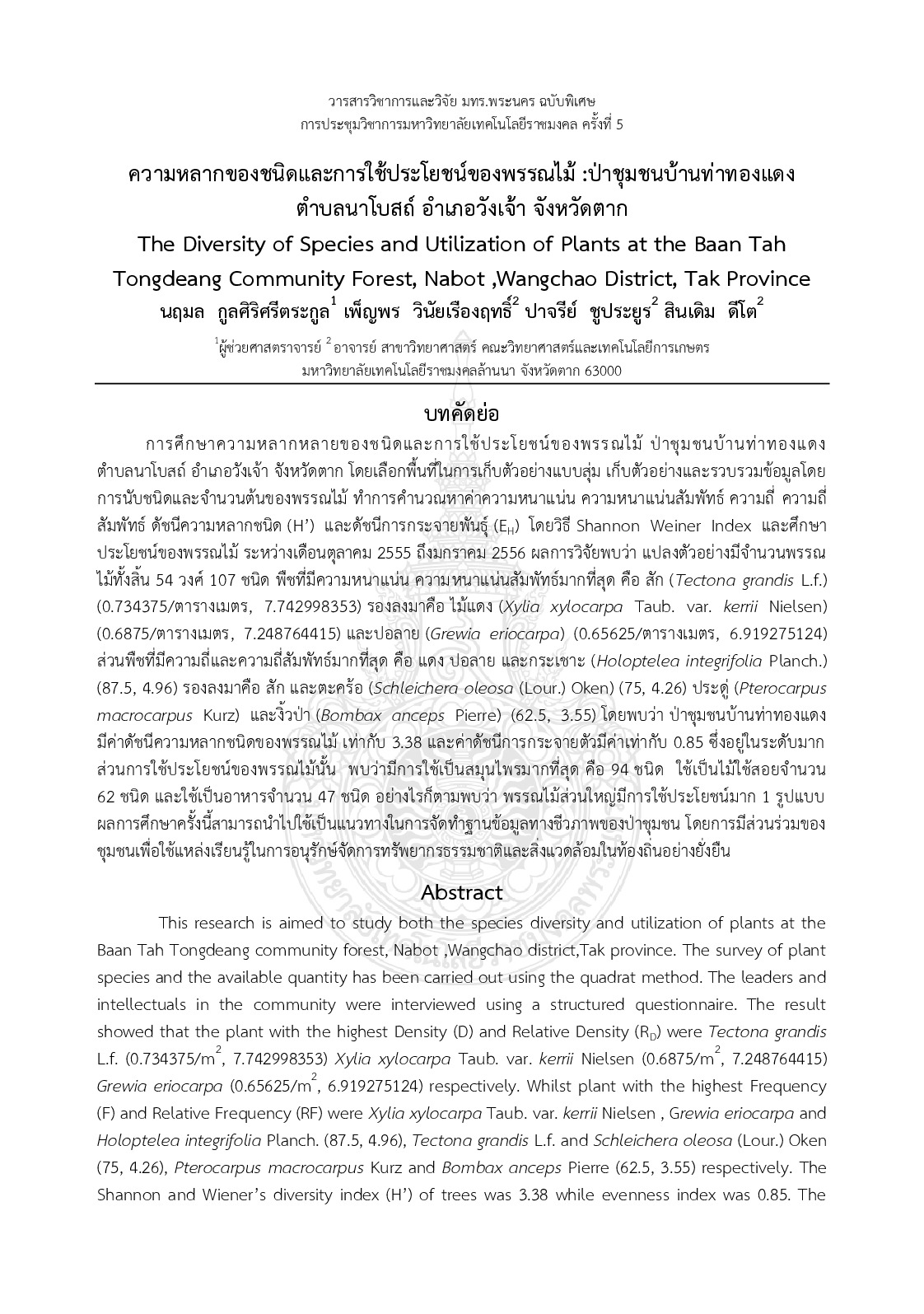
This research is aimed to study both the species diversity and utilization of plants at the Baan Tah Tongdeang community forest Nabot Wangchao districtTak province. The survey of plant species and the available quantity has been carried out using the quadrat method. The leaders and intellectuals in the community were interviewed using a structured questionnaire. The result showed that the plant with the highest Density (D) and Relative Density (RD) were Tectona grandis L.f. (0.734375/m2 7.742998353) Xylia xylocarpa Taub. var. kerrii Nielsen (0.6875/m2 7.248764415) Grewia eriocarpa (0.65625/m2 6.919275124) respectively. Whilst plant with the highest Frequency (F) and Relative Frequency (RF) were Xylia xylocarpa Taub. var. kerrii Nielsen Grewia eriocarpa and Holoptelea integrifolia Planch. (87.5 4.96) Tectona grandis L.f. and Schleichera oleosa (Lour.) Oken (75 4.26) Pterocarpus macrocarpus Kurz and Bombax anceps Pierre (62.5 3.55) respectively. The Shannon and Wiener’s diversity index (H’) of trees was 3.38 while evenness index was 0.85. The utilization of the plants in the community included 94 species as wood (used as plank furniture firewood charcoal string chemical extraction etc. 62 species as medicinal herbs 47 species as wild vegetables fruits and foods. All of them are utilized in the community. The results of this research would be beneficial for administrative and management as a guideline to preparation a community biological database and learning resources for conservation and sustainable uses of natural resources and environments in Baan Tah Tongdeang community forest.

Rice production technology and cost benefit of smallholder farmer in rice community center : A Case Study Ban Phap, Phapayome District Phattalung Province
This research had objectives for the purpose of studied the rice production technology and cost benefit of farmer members in community rice seed centers (CRSC). The research case study was conducted in Phatthalung province by field surveys combining participatory rural appraisal and structured interview of 35 members during the research period from April 2012-August 2012. The CRSC received contribution grain from government service. The result showed that majority rice community center member were men and in one family had average 2 workers. Their ages between 51-60 years old. The Majority of education were primary school (grade 4). The cultivated area of rice between 11-20 rais. Rice production can generally be divided into the following 10 stages that is soil improvement land preparation crop establishment plantation water management nutrient management pet control weed control harvesting and post harvest. The results of the study found that almost all farmer using private land (69.72 %). The important expense was variable cost 80.25 % Ban-Phab is 3509 bath per rais. Average benefit per rais is 6985.04 bath per rais. The rice break- event point is 317.56 kg per rai. However return on investment explore CRSC Ban-Phab is 99.06 %
Exciting permanent-magnetic-field affecting to the bean sprout growing
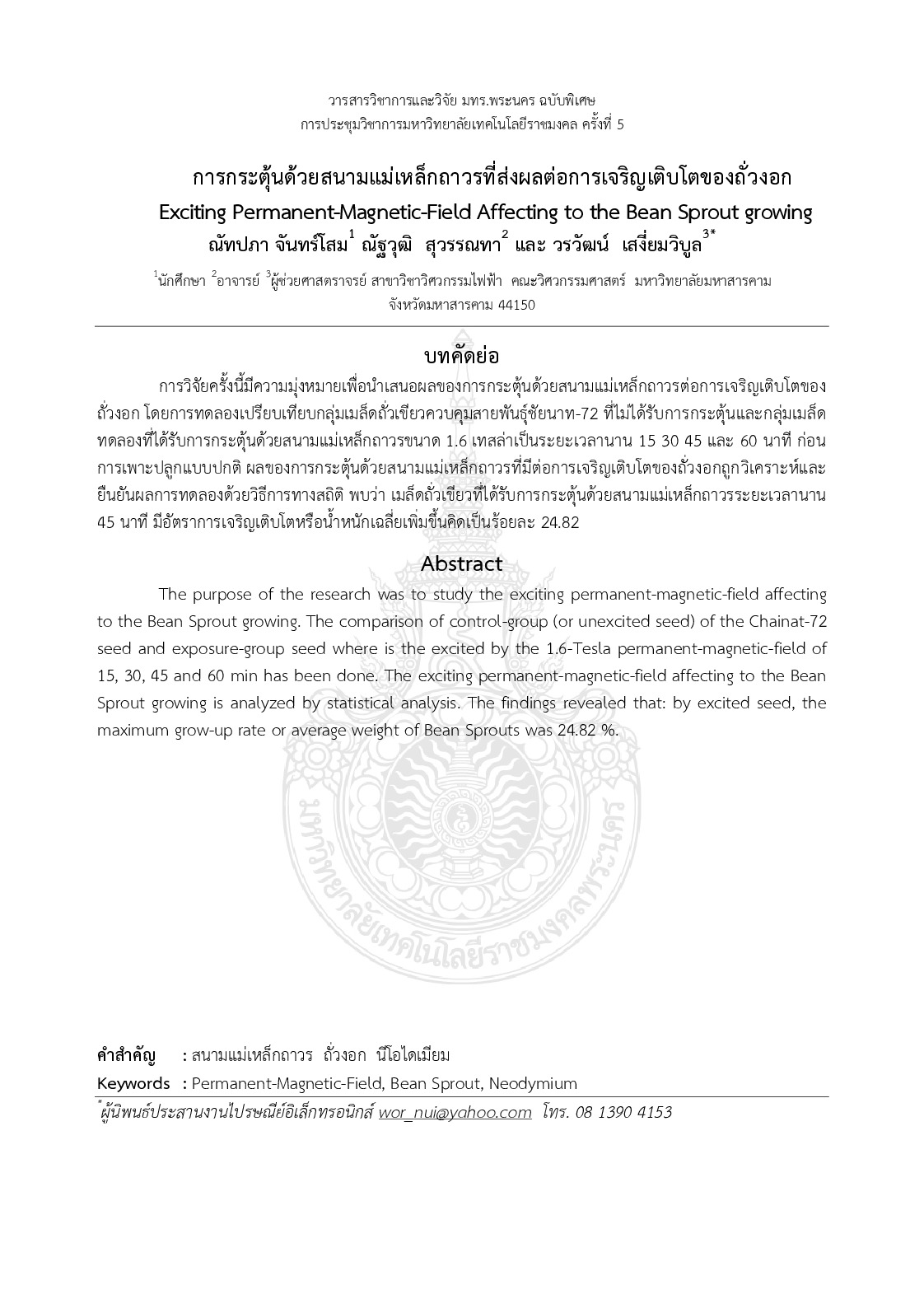
The purpose of the research was to study the exciting permanent-magnetic-field affecting to the Bean Sprout growing. The comparison of control-group (or unexcited seed) of the Chainat-72 seed and exposure-group seed where is the excited by the 1.6-Tesla permanent-magnetic-field of 15 30 45 and 60 min has been done. The exciting permanent-magnetic-field affecting to the Bean Sprout growing is analyzed by statistical analysis. The findings revealed that: by excited seed the maximum grow-up rate or average weight of Bean Sprouts was 24.82 %.
The design of floating house for use in thailand
This research is about analyzing the design of floating houses including area function structure and construction materials. Floating houses design are energy saving and security. The materials must be strong and durable. Moreover the materials must be resistant to moisture because floating houses are situated over the water which causes the high levels of moisture and rust. And the risk of corrosion. The researcher recognizes that this is important. research concludes as the followings :- 1. From the designs of floating house the shape of floating house is a triangular. The structure has 3 main parts connected as space frame making the structure to be very strong. 2. The function of used area inside the floating house has been considered about ventilation in the most effective way. There are an opened windows and doors for good air flow. 3. Regarding to the use of construction materials there are comparisons between 3 types of materials in order to choose the best type which is very durable for this floating house. 4. Structure Using steel structure that enhances strength durable easy to use and demolition.
Development of allooyseem motif silk fabric : a case study of wat ban kradonmaidang silk weaver group in krasung district, buriram province
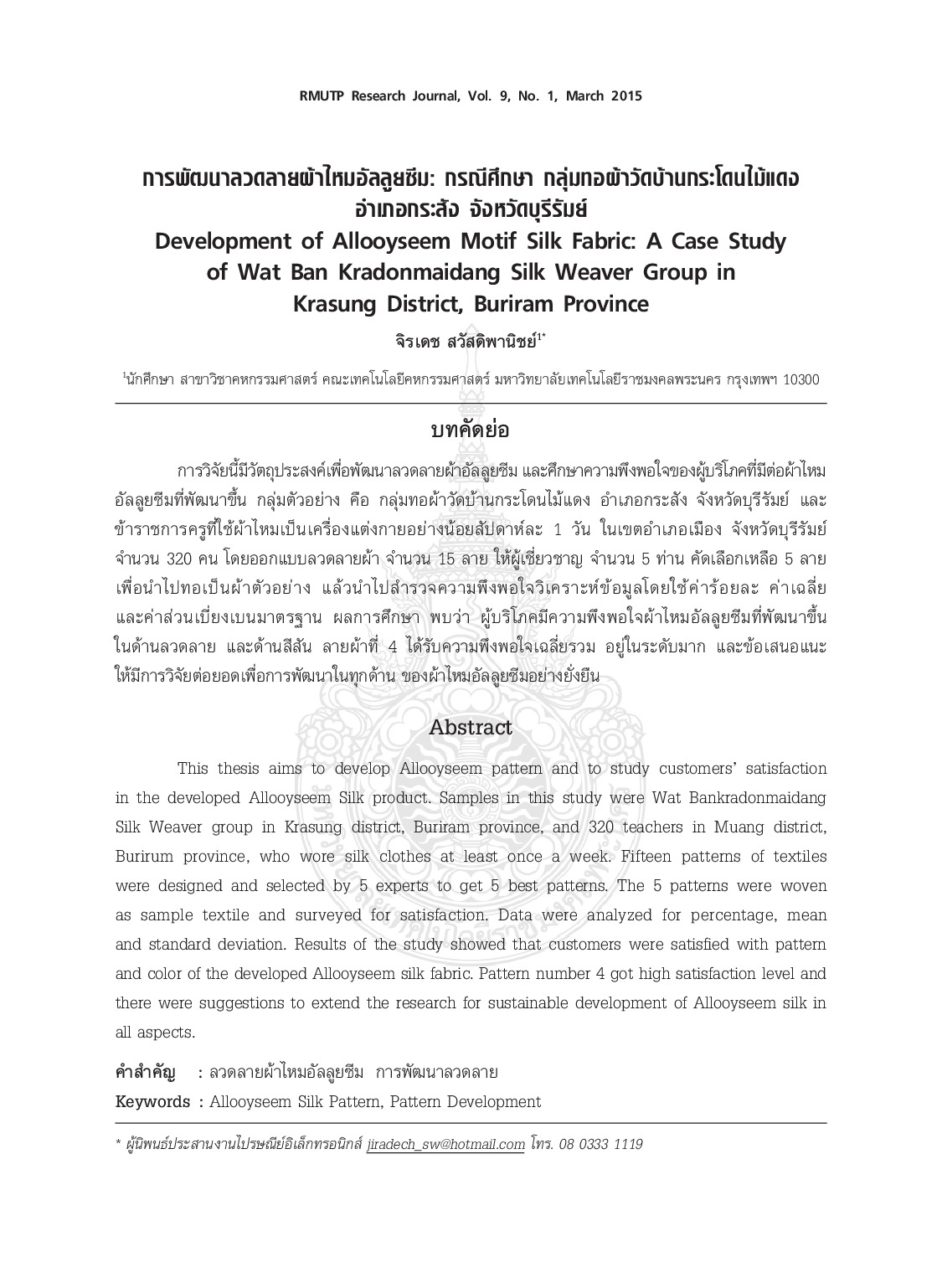
This thesis aims to develop Allooyseem pattern and to study customers’ satisfaction in the developed Allooyseem Silk product. Samples in this study were Wat Bankradonmaidang Silk Weaver group in Krasung district Buriram province and 320 teachers in Muang district Burirum province who wore silk clothes at least once a week. Fifteen patterns of textiles were designed and selected by 5 experts to get 5 best patterns. The 5 patterns were woven as sample textile and surveyed for satisfaction. Data were analyzed for percentage mean and standard deviation Results of the study showed that customers were satisfied with pattern and color of the developed Allooyseem silk fabric. Pattern number 4 got high satisfaction level and there were suggestions to extend the research for sustainable development of Allooyseem silk in all aspects.