จำนวน Repository ( 3611 )

การออกแบบเนื้อหาบทเรียนและการสร้างสื่อการสอนเกี่ยวกับประชาคมเศรษฐกิจอาเซียน สำหรับวิชาการเขียนภาษาอังกฤษ
The purposes of this research were to design contents build both document-based and electronic-based teaching materials and find out the students’ satisfaction towards the use of ASEAN Economic Community related lessons for English writing courses. The sample group consisted of two 30-student sections of totally 60 third-year undergraduate students majoring in English for International Communication faculty of Liberal Arts Rajamangala University of Technology Phra Nakhon. After they had tried using the lessons did the document-based exercises answered the first questionnaire tried the electronic-based exercises and answered the second questionnaire their data were analyzed and revealed as follows. 1. The analysis of the first questionnaire revealed that the students’ average satisfaction towards the English writing content lessons was in the highly middle level with 3.15 out of 5 points or 63 per cent. 2. The analysis of the first questionnaire also revealed that the students’ average satisfaction towards the English writing document-based exercises was again in the highly middle level with 3.38 out of 5 points or 67.67 per cent. 3. The analysis of the second questionnaire revealed that the students’ average satisfaction towards the English writing electronic-based exercises was in the high level with 3.65 out of 5 points or 72.98 per cent. In comparison there was a difference of 0.27 points or 5.31 per cent between the students’ satisfaction towards the electronic-based exercises and that towards the document-based exercises implying that the students preferred the electronic-based exercises to the document-based exercises.
การศึกษากรรมวิธีการทำเปลือกแตงโมปรุงรส
The research on “A Study of Seasoning Watermelon shell Process ” had objectives of study to develop product of Watermelon shell jam from changing the prototype recipe of pineapple jam. The researchers altered the recipe by using Watermelon shell to replace 100 per cent pineapple texture in three recipes to be put additionally into water melon texture in three different content 20 per cent 30 per cent and 40 per cent of the total weight of Watermelon shell . The researcher studied about the process of making flavored Watermelon shell in order to study three types of appropriate and different processes of Watermelon shell including diced Watermelon shell chopped Watermelon shell and ground Watermelon shell in homogenous texture. From the study it was found that study of pineapple jam recipe was in prototype recipe; altering the recipe by using Watermelon shell to replace 100% pineapple texture. Then the researchers had tasting persons taste three basic recipes and found that tasting persons accepted recipe No. 2 in the total aspects of color scent flavor texture and fondness. The scores were 7.93?0.62 8.25?0.56 7.80?0.54 7.63?0.70 and 7.68?0.57 respectively; the fondness was from moderate level to much fondness. When variance was analyzed and statistical difference was searched it was found that total features of color scent flavor texture and fondness did not have significant difference at level of 0.05. From study it was found that study of process of making flavored Watermelon shell in three types including diced watermelon shell chopped watermelon shell and ground Watermelon shell in homogenous texture it was found that tasting persons accepted recipe No. 1 (diced Watermelon shell ) in total color scent flavor texture and fondness having mean value at 8.03?0.66 8.50?0.64 8.28?0.55 7.98?0.66 and 7.93?0.35 respectively in the level of moderate fondness to much fondness. When variance was analyzed and statistical difference was searched it was found that total features of color scent flavor texture and fondness had significant difference at level of 0.05.
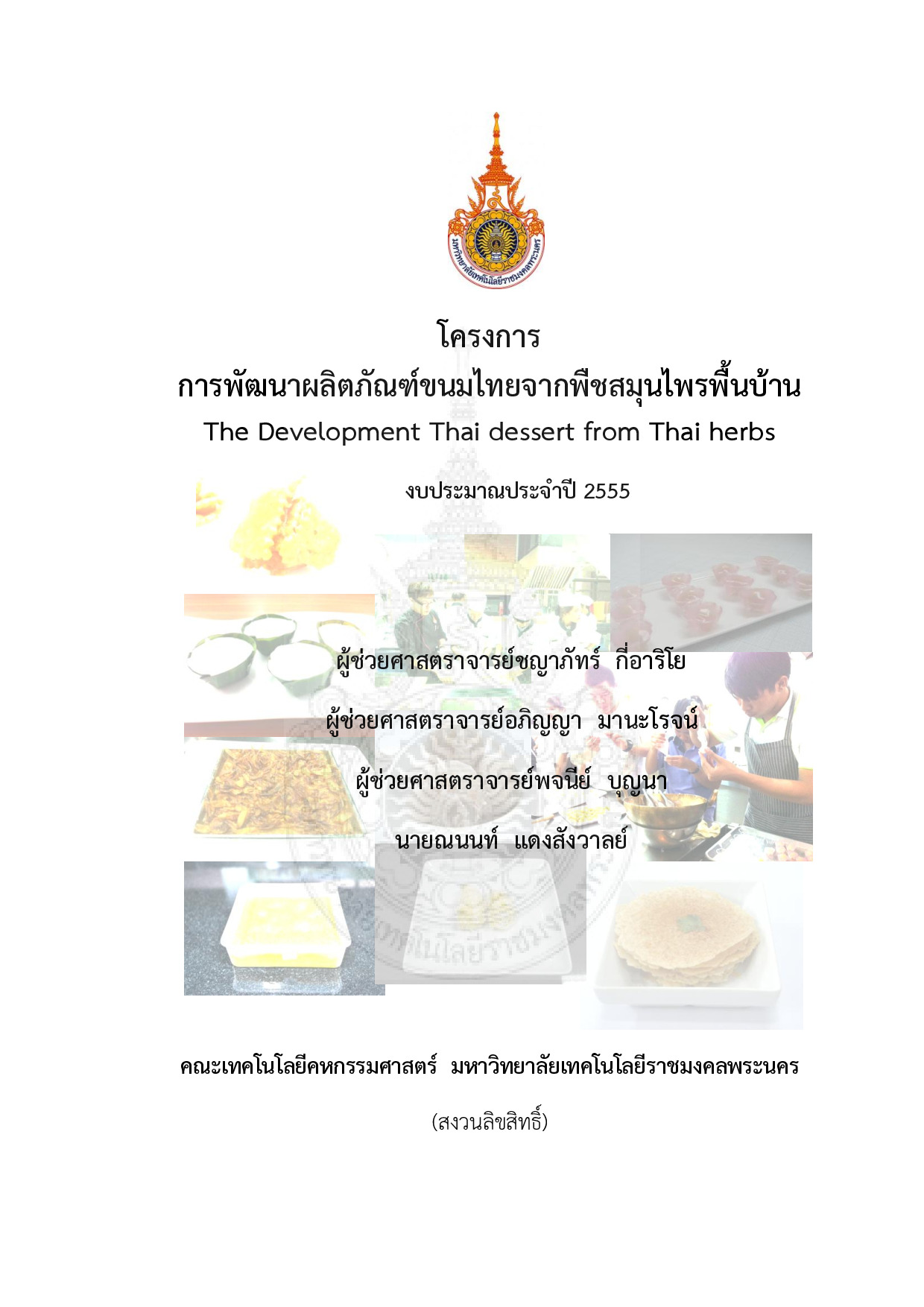
การพัฒนาผลิตภัณฑ์ขนมไทยจากพืชสมุนไพรพื้นบ้าน
The studies of original recipes of Thai desserts were modified and developed by local Thai herb. There are eight kinds of Thai dessert were selected such as Ta – Ko Mao-Kang (Thai baked custard) Shung–Ha-Ya (Thai streamed custard) Toa-Pap Krob-Kim Ka-Nom-Tom Ka-Nom-Tein-Kaew and Kaow-Tung-Sa-Wey which were developed by dried sweet bael fruit Curcuma powder Mashed lemongrass and Mashed ginger. A result was found that Ta – ko substitution water chestnut from dried sweet bael fruit (marmelos) in level of bael fruit was 100 125 and 150 % by weight of water chestnut. The food expertises like substitution dried sweet bael fruit with 125 % in moderate level. The majority of consumer 85% accepted Ta –ko with 125% of dried sweet bael fruit. Mao-kang was added dried sweet bael fruit in levels of bael fruit was 10 20 and 30% by total weight. The food expertises like added sweet bael fruit with 20% in moderate level. The majority of consumer 95% accepted Maokang with 20 % of dried sweet bael fruit. Shung–ha-ya was added curcuma powder in levels of curcuma powder was 0.5 0.75 and 1% by total weight. The food expertises like added curcuma powder with 0.5% in moderate level. The majority of consumer 81% accepted shung–ha-ya with 0.5% of curcuma powder. Ka-nom-Toa-pap was added curcuma powder in levels of curcuma powder was 1 2 and 3% by total weight. The food expertises like added curcuma powder with 2% in moderate level. The majority of consumer 84% accepted ka-nom-Toa-papwith 2% of curcuma powder. Krob-kim was added mashed lemongrass in levels of mashed lemongrass was 6 8 and 10% by total weight. The food expertises like added mashed lemongrass with 10% in moderate level. The majority of consumer 94% accepted Krob-kim with 10% of mashed lemongrass. Ka-nom-Tom was added mashed lemongrass in levels of mashed lemongrass was 10 15 and 20% by total weight. The food expertises like added mashed lemongrass with 15% in moderate level. The majority of consumer 87% accepted Ka-nom-Tom with 15% of mashed lemongrass. Ka-nom-tein-kaew and kaow-tung-sa-wey was added mashed ginger in levels of mashed ginger was 4 8 and 12% by total weight. The food expertises like added mashed ginger 4% in two products. They like in moderate level. The majority of consumer 79 % accepted Ka-nom-tein-kaew and 93% accepted kaowtung-sa-wey with 4% mashed ginger.
ผลการจัดการเรียนรู้แบบร่วมมือเชิงบูรณาการ วิชาเทคนิคการจัดดอกไม้ ของนักศึกษา ระดับปริญญาตรี สาขาวิชาการบริหารธุรกิจคหกรรมศาสตร์ มทร.พระนคร
The research studied results of integrated learning management in flower arrangement techniques subject of students from the bachelor’s degree in Home Economics Business Administration program Rajamangala University of Technology Phra Nakhon. The researchers provided the cooperative learning and selected three units of flower arrangement techniques subject consisting of materials and tools for arranging flowers creative flower arrangement and international flower arrangement. The research samples were the second year students of Home Economics Business Administration program. The research methods used in this study were a learning achievement form a satisfaction form and a participant observation form. Results of the study found were: 1. The effects of cooperative learning on students flower arrangement techniques subject achievement was found that there was a statistically significant difference between students pretest and post-test scores at the level .05. 2. The satisfaction of students toward flower arrangement techniques subject was at the highest level ( x = 4.00). It showed that students’ attitudes toward cooperative learning were at good level.
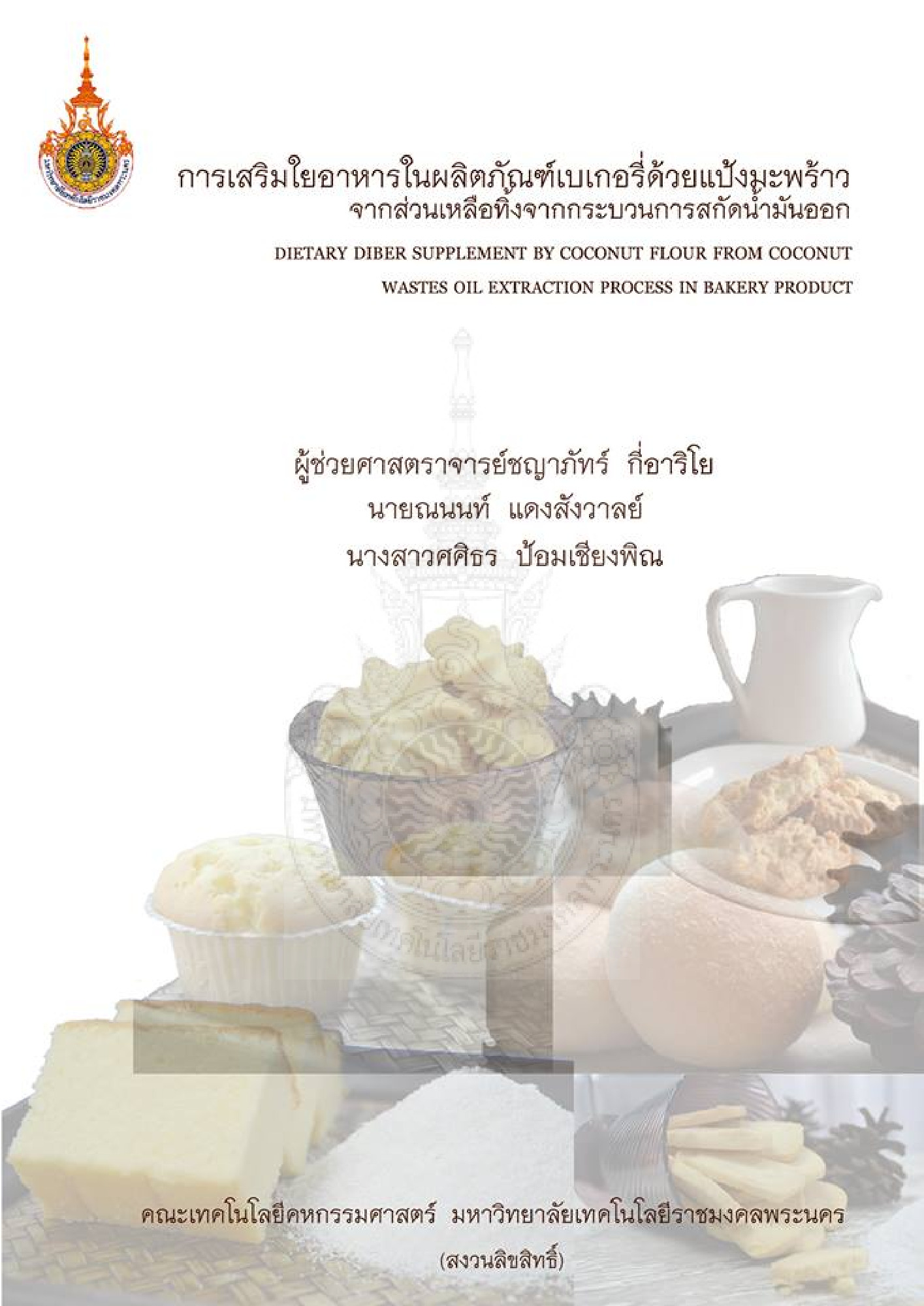
การเสริมใยอาหารในผลิตภัณฑ์เบเกอรี่ด้วยแป้งมะพร้าวจากส่วนเหลือทิ้งจากกระบวนการสกัดน้ำมันออก
The studies of Dietary Fiber Supplement by coconut flour from coconut Wastes Oil Extraction process in Bakery Product was investigated Production of coconut flour from coconut wastes oil extraction drying at 55 ° C for 12 hours and then grinding to powder gave the off-white fine powder. The chemical compositions of coconut flour were 57.70 % carbohydrate 29.4 % fat 6.23 % moisture 5.20 % protein and 1.48 % ash by dye weigh. Butter cake making experiment by substitution of wheat flour with coconut flour at 5 % of wheat flour weigh which has the highest sensory scores comparing butter cake with the control found that increase dietary fiber 1.34 g. /100 g. The majority of the tested consumers (92%) accepted butter cake with 5 % of coconut flour substitution. Muffin making experiment by substitution of wheat flour with coconut flour at 15 % of wheat flour weigh which has the highest sensory scores comparing muffin with the control found that increase dietary fiber 2.34 g /100 g. The majority of the tested consumers (81%) accepted muffin with 15 % of coconut flour substitution. Cornflake cookie making experiment by substitution of wheat flour with coconut flour at 20 % of wheat flour weigh which has the highest sensory scores comparing cornflake cookie with the control found that increase dietary fiber 3.54 g. /100 g. The majority of the tested consumers (94 %) accepted cornflake cookie with 20 % of coconut flour substitution. Butter cookie making experiment by substitution of wheat flour with coconut flour at 10 % of wheat flour weigh which has the highest sensory scorescomparing butter cookie with the control found that increase dietary fiber 3.04 g. /100 g. The majority of the tested consumers (94 %) accepted Butter cookie with 10 % of coconut flour substitution. Frozen cookie making experiment by substitution of wheat flour with coconut flour at 20 % of wheat flour weigh which has the highest sensory scores comparing cookie with the control found that increase dietary fiber 4.02g. /100 g. The majority of the tested consumers (93 %) accepted 20 % of coconut flour substitution. Butter bread making experiment by substitution of wheat flour with coconut flour at 15 % of wheat flour weigh which has the highest sensory scores comparing butter bread with the control found that increase dietary fiber 2.22 g. /100 g. The majority of the tested consumers (75 %) accepted 15% of coconut flour substitution. Whole wheat bread making experiment by substitution of wheat flour with coconut flour at 15 % of wheat flour weigh which has the highest sensory scores comparing whole wheat bread with the control found that increase dietary fiber 2.09 g. /100 g. The majority of the tested consumers (79 %) accepted 15 % of coconut flour substitution. Pie crust making experiment by substitution of wheat flour with coconut flour at 15 % of wheat flour weigh which has the highest sensory scores comparing pie crust with the control found that increase dietary fiber 2.91 g. /100 g. The majority of the tested consumers (82 %) accepted 15 % of coconut flour substitution.