จำนวน Repository ( 3611 )
The Development of New Mixed Fiber from Waste Cocoon and Other Plant Fibers
The purpose of this project is to develop the production Process of the blend fibers from the remnants of waste cocoons and plant fibers by the experiment of the handicraft products. The result showed that the remnants of cocoons and 5 types of blends and the other plant fibers were mixed; namely cotton fibers linen fibers ramie fibers pineapple fibers and the hemp fibers. The physical properties were performed as follow: the first breaking strength the breaking strength of the woven fabric from the remnants of cocoons and linen fibers were 155 CN/tex. The second breaking strength of the woven fabric from the remnants of waste cocoons and the Indian hemps were 149 CN/tex. The third breaking strength of woven fabric from the remnants of waste cocoons and cotton fibers were 142 CN/tex. The forth breaking strength of woven fabric from the remnants of cocoons and pineapple fibers was 108 CN/tex. The result showed that the woven fabric from the 5 types of these blends had the potential to be applied in the household textile products
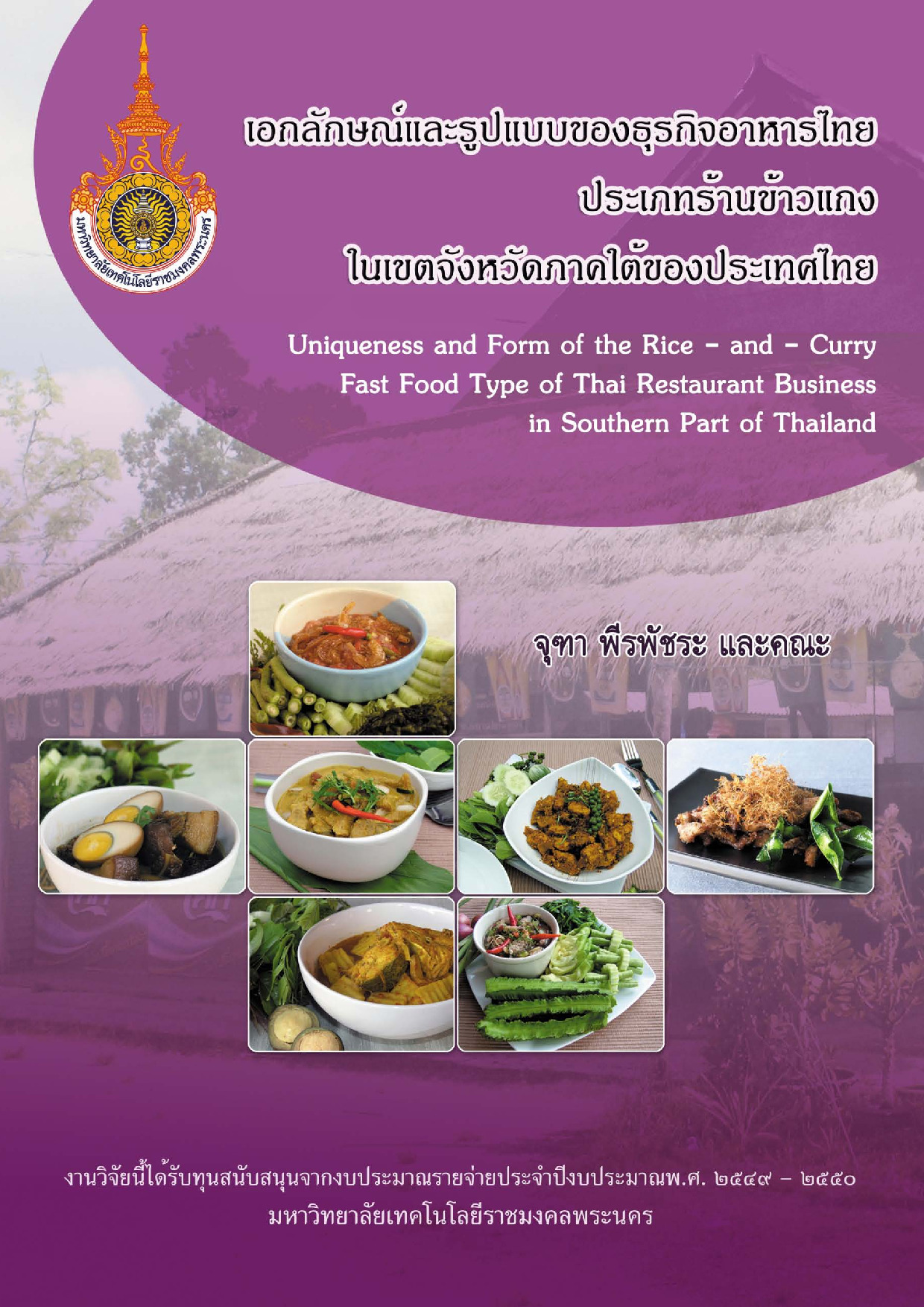
Uniqueness and Form of the Rice - and - Curry Fast Food Type of Thai Restaurant Business in Southern Part of Thailand
The research on uniqueness and form of the rice-and-curry fast-food type of Thai restaurant business in southern part of Thailand is a combined quantitative and qualitative research which aims to study the uniqueness of the rice-and-curry fast-food type of Thai restaurant business in terms of raw materials and cooking method. It has three main purposes: to study the form of the rice-and-curry fast-food type of Thai restaurant business in terms of administration decoration and sale in order to compare the uniqueness of Thai rice-and-curry fast-food in each province; to compare the form of rice-and-curry fast-food type of Thai restaurant business in each province; and to organize standard recipes for Thai rice-and-curry fast-food in southern provinces of Thailand. The sample used in this research were rice-and-curry fast-food shops from Nakhon Sri Thammarat Krabi Phang-nga Songkhla and Satun provinces - 5 shops each - with a total of 25 shops. The tool used in this study consisted of survey questionnaire food test questionnaire and record form for food recipe raw materials and equipment. Data were collected bymeans of survey and interview and were statistically analyzed for frequency and percentage together with a qualitative analysis.
Use of Reading Strategies in English Academic Reading
The purpose of this study was to investigate how Thai undergraduate students do to improve their reading comprehension skills. This paper presents a qualitative investigation. A semi-structured interview is served as the main source of data. Forty students from different faculties of Khon Kaen University participated in the study. The transcribed interview data was analyzed with ‘open and axial coding’ techniques. The data analyses revealed two main emergent categories of reading strategies: 1) reading comprehension strategies (RC); and 2) reading comprehension enhancement strategies (RCE) with altogether 39 individual reading strategies. The interview result showed that the most frequently found strategies being reported were from the first category e.g. looking for unfamiliar vocabulary items and then searching for their meanings before reading (BRC 1) and searching for the meanings of unfamiliar vocabulary items while reading (WRC 1). On the contrary the students reported not to rely heavily on the strategies from the second category
Core Competency Indicator of The Department of Corrections’ Employees from The Second Order Factor Analysis
This research objective is to find Core Competency Indicator of the Department of Corrections’ Employees The researcher collects data from those of 11437 employees and executives of the Department of Corrections. A proportion Sampling of to the method of Thompson is used to define sample size. At 95% level of confidence the sample size is equal to 372 samples but the researcher puts more 10% to the sample size in order to avoid problem of incomplete answers and gets 410 samples as a target. The Probability Sampling is used through the technique of Stratified random sampling. Finally 410 surveys are collected. The quantitative analysis is used through the Second Orders Factor Analysis by LISREL Program. The finding of research is that Core Competency Indicator of the Department of Corrections’ Employees derives firstly from Managerial Competencies secondly from Leadership Competencies and lastly fromTask Achievement Competencies