จำนวน Repository ( 3611 )
Creating and Evaluating the Effectiveness of Computer Assisted Instruction Program Subject Engineering Materials Chapter 3-6.
The purposes of the research were to create and efficiency validation of computer Assisted for the courses of practiced to reading Creating and Evaluating the Effectiveness of Computer Assisted Instruction Program Subject Engineering Materials Chapter 3-6 based standard and analyses the leaning achievement of the student after by using computer assisted instruction . The subjects in the study were 20. Diploma students enrolled in Rajamangala University of Technology Phra Nakhon. The Researcher using the experiment by let the students do until test before class And then study by using computer assisted instruction focused on practiced to basic turning . After that let students do the unit test again at the class and calculate to find out the efficiency of the computer assisted instruction. And analyzed the learning achievement of students after study. The research result revealed that the efficiency of the computer assisted Instruction was efficient in standard Moreover after learning achievement at significant level of 0.05.

Creating and evaluating the effectiveness of computer assistedInstruction program subject manufacturing processes chapter 5-8.
The purposes of the research were to create and efficiency validation of computer Assisted for the courses of practiced to reading Creating and Evaluating the Effectiveness of Computer Assisted Instruction Program Subject Manufacturing Processes Chapter 5-8. based standard 90/90 and analyses the leaning achievement of the student after by using computer assisted instruction . The subjects in the study were 25 first year. Diploma students enrolled in Rajamangala University of Technology Phra Nakhon. The Researcher using the experiment by let the students do until test before class And then study by using computer assisted instruction focused on practiced to basic turning . After that let students do the unit test again at the class and calculate to find out the efficiency of the computer assisted instruction. And analyzed the learning achievement of students after study. The research result revealed that the efficiency of the computer assisted Instruction was efficient in standard 90/90 Moreover after learning achievement at significant level of 0.05.
Development of Process for Recovery Metal Carbide Powder from Cemented Tungsten Carbide Scraps
The recycling of materials is the recovered process and the important approach for sustainable development. This research is to study recycling tungsten carbides from cemented carbide scraps by extracting the dissolved of binder phase and to study the un-dissolved substrate which stayed condition and size in WC particles. The experiment of this research starts in laboratory with electrolysis is found that the appropriate operating potential is 0.20-1.40 volts at 30-80 oc treated in 1N-7N HCl concentrations aqueous solution as well as the movement of solution and specimens had an effect on capacity of dissolution. Additionally these factors are affected to purity and passivation of WC particles. According to the above experiment it leads to design and create the semi-automatic cemented dissolution machine with electrolysis. This machine can contain the scraps up to 2.5 kilograms in rev 0-25 rpm (revolutions per minute) at electric current 0-50 ampere in electric voltage 0-15 volts. Its flowing process can be 15 lpm (litre per minute) and minute) and temperature is up to 90 oc. Furthermore there are the relative WC power invention processes included residues washing leaching ball milling drying screening and quality examination. The result of developed machine is capacity of tungsten carbide production is in the range 16-50 gram/hour the obtained powder is 97.49% of tungsten carbide (WC powder) which contained a few amount of cobalt. However the dissolution of cemented carbides with this machine can be selected the optimized factors to produce tungsten carbide (WC) to purify more than 99% ball milled them in the most suitable size and particle sized distribution between 0.30-20.00 μm. Afterwards combining cobalt 15% (WC-15%Co) and producing to cemented carbides insert tools rectangle as SNMG standard 120408 it appears that insert tools has a hardness not less than 1430 HV density not less than 14.10 g/cm³. In the other hands the production of tungsten carbides with advanced technology of dissolution machine and manufacturing machine to produce purely tungsten carbides powder has been required an investment charge of new research and development more than 9481888 baht.
Analysis of steel industries in thailand : Case study of production planning and control by determination of time limited free back orders.
The objectives of this research were to find the distribution of food demand for laying hens and to find the optimum amount of that food production which had minimum cost. The data consisted of customer purchase orders for the food of laying hens price of food for laying hens cost per unit for the food inventory cost related to food of laying hens in which the food was out of stock such as fine overtime urgent purchase for material. They were collected in 2008-2009 form a factory in Nakhonratchasima province. The collected data were analized in order to explore the distribution of the monthly food demand for the laying hens and to see the rate of inventory per unit. The results were used in the stochastic linear programming model for aggregate planning in which the optimum production minimum cost could be obtained. Programming algorithm in MATLAB and tools in Linprog software were used to get the solution. The distribution of the food demand for laying hens and the random numbers were used in the model. The study found that the distribution of food demand for laying hens every month has normal distribution (January to December). The monthly average amount of production from January to December were 10936.94 12913.74 11898.12 13096 15443.26 14916.33 10322.64 10818.21 11393.11 11700.72 9706.05 and 11702.05 respectively. The minimum total cost average for 12months was Baht 62422386.98.
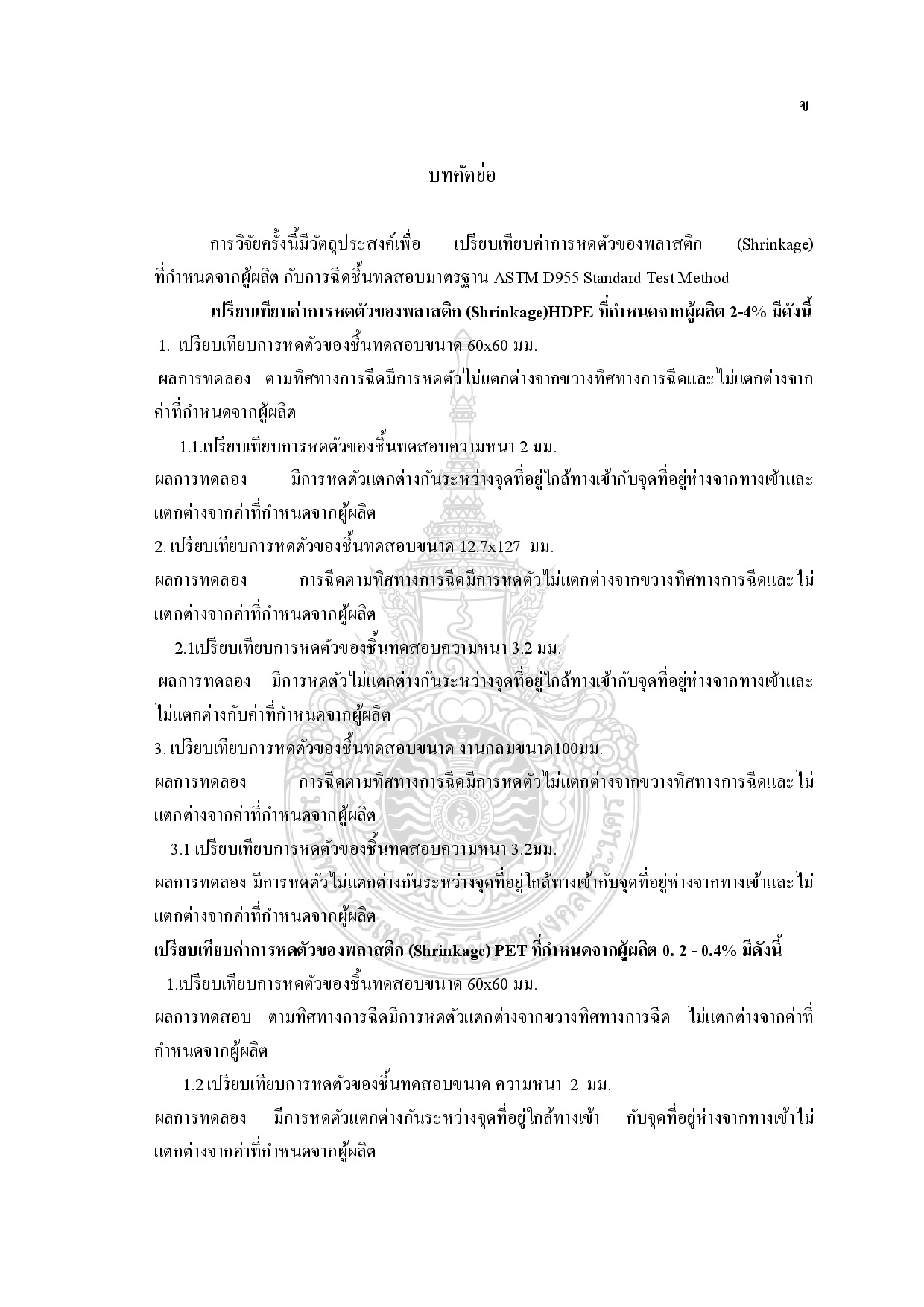
This research aims to compare the shrinkage value that limited from manufacturer with the ASTM D955 Standard Test Method
Comparing the shrinkage values of HDPE 2 – 4 % that limited from manufacturer are as the following: 1. Comparing the shrinkage of 60 X 60 mm. specimen The result showed that there aren’t any shrinkage differences among follow the injection across the injection and the limited value from the manufacturer. 1.1 Comparing the shrinkage of the specimen with 2 mm. thick The result showed that the shrinkage between at the point nearby the entrance is different from at the point further from the entrance and it is also different from the limited value from the manufacturer. 2. Comparing the shrinkage of 12.7 X 27 mm. specimen The result showed that there aren’t any shrinkage differences among follow the injection across the injection and the limited value from the manufacturer. 2.1 Comparing the shrinkage of the specimen with 3.2 mm. thick The result showed that there aren’t any shrinkage differences among the point nearby the entrance the point further from the entrance and the limited value from the manufacturer. 3. Comparing the shrinkage of 100 mm. round specimen The result showed that there aren’t any shrinkage differences among follow the injection across the injection and the limited value from the manufacturer. 3.1 Comparing the shrinkage of the specimen with 3.2 mm. thick The result showed that there aren’t any shrinkage differences among the point nearby the entrance the point further from the entrance and the limited value from the manufacturer. Comparing the shrinkage values of PET 0.2 - 0.4% that limited from manufacturer are as the following: 1. Comparing the shrinkage of 60 X 60 mm. specimen The finding revealed that the shrinkage value of the follow injection is different from the across injection but it is not different from the limited value from the manufacturer. 1.2 Comparing the shrinkage of the specimen with 2 mm. thick The finding revealed that the shrinkage value between the point nearby the entrance and the point further from the entrance are different but the same as the limitation from the manufacturer. 2. Comparing the shrinkage of 12.7 X 27 mm. specimen The finding revealed that the shrinkage value of the follow injection is different from the across injection but the same as the limited value from the manufacturer. 2.1 Comparing the shrinkage of the specimen with 3.2 mm. thick The result showed that there aren’t any shrinkage differences among follow the injection across the injection and the limited value from the manufacturer. 3. Comparing the shrinkage of 100 mm. round specimen The finding revealed that the shrinkage value of the follow injection is different from the across injection but it is not different from the limited value from the manufacturer. 3.1 Comparing the shrinkage of the specimen with 3.2 mm. thick The finding revealed that the shrinkage value of the follow injection the across injection and the limited value from the manufacturer are the same. Both comparing HDPE and PET have statistical significance at 0.05