จำนวน Repository ( 3611 )
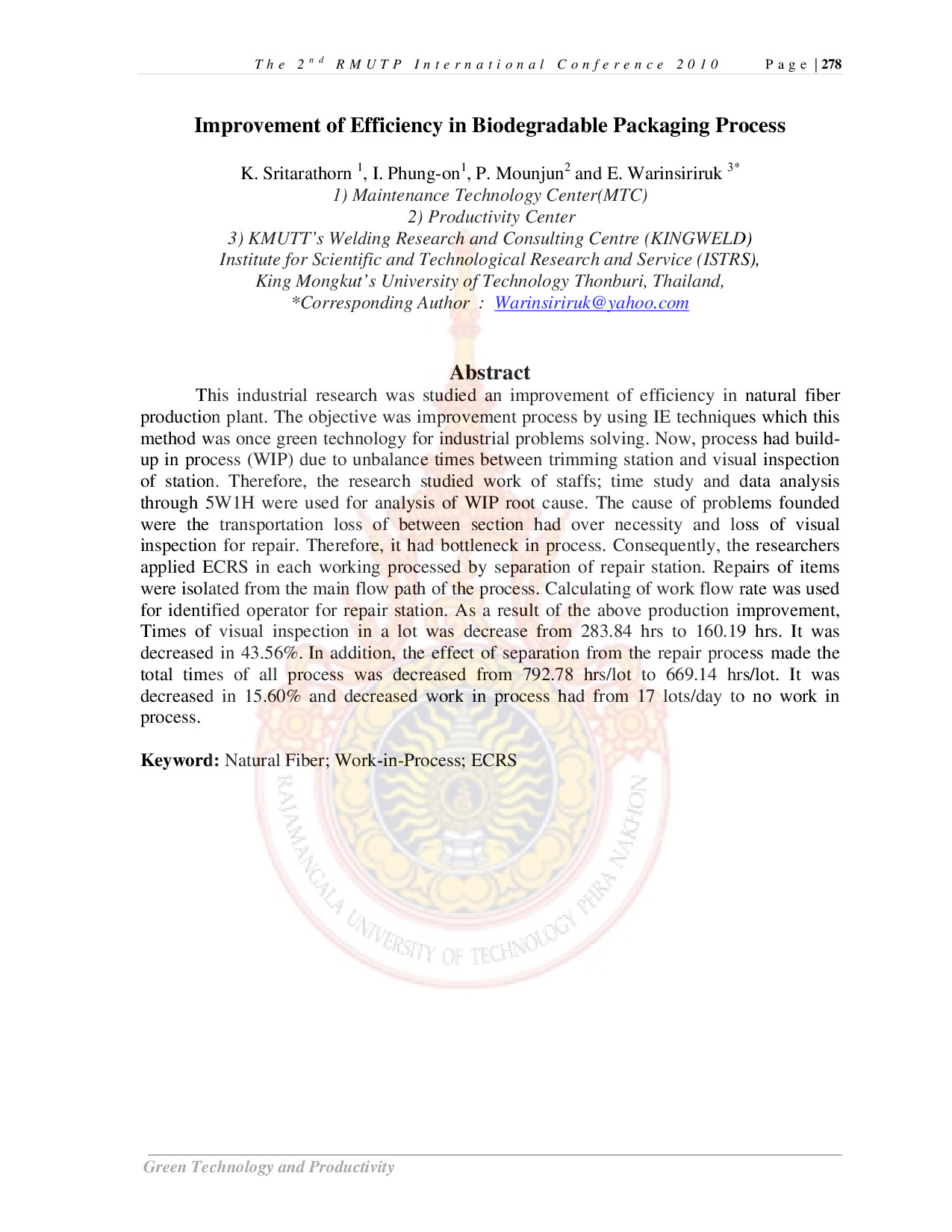
Improvement of Efficiency in Biodegradable Packaging Process
This industrial research was studied an improvement of efficiency in natural fiber production plant. The objective was improvement process by using IE techniques which this method was once green technology for industrial problems solving. Now process had build-up in process (WIP) due to unbalance times between trimming station and visual inspection of station. Therefore the research studied work of staffs; time study and data analysis through 5W1H were used for analysis of WIP root cause. The cause of problems founded were the transportation loss of between section had over necessity and loss of visual inspection for repair. Therefore it had bottleneck in process. Consequently the researchers applied ECRS in each working processed by separation of repair station. Repairs of items were isolated from the main flow path of the process. Calculating of work flow rate was used for identified operator for repair station. As a result of the above production improvement Times of visual inspection in a lot was decrease from 283.84 hrs to 160.19 hrs. It was decreased in 43.56%. In addition the effect of separation from the repair process made the total times of all process was decreased from 792.78 hrs/lot to 669.14 hrs/lot. It was decreased in 15.60% and decreased work in process had from 17 lots/day to no work in process.
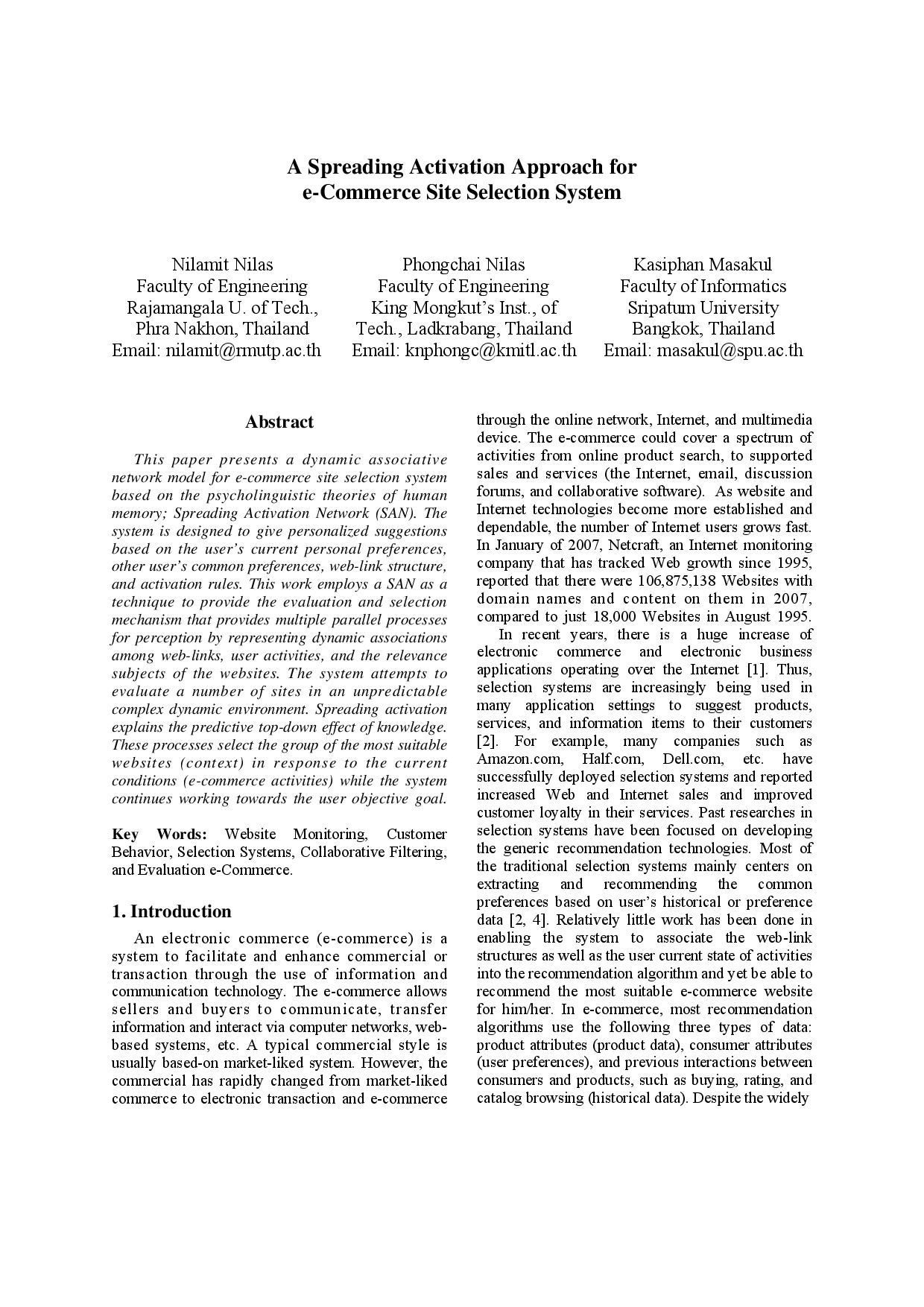
A Spreading Activation Approach for e-Commerce Site Selection System
This paper presents a dynamic associative network model for e-commerce site selection system based on the psycholinguistic theories of human memory; Spreading Activation Network (SAN). The system is designed to give personalized suggestions based on the user’s current personal preferences other user’s common preferences web-link structure and activation rules. This work employs a SAN as a technique to provide the evaluation and selection mechanism that provides multiple parallel processes for perception by representing dynamic associations among web-links user activities and the relevance subjects of the websites. The system attempts to evaluate a number of sites in an unpredictable complex dynamic environment. Spreading activation explains the predictive top-down effect of knowledge. These processes select the group of the most suitable websites (context) in response to the current conditions (e-commerce activities) while the system continues working towards the user objective goal.
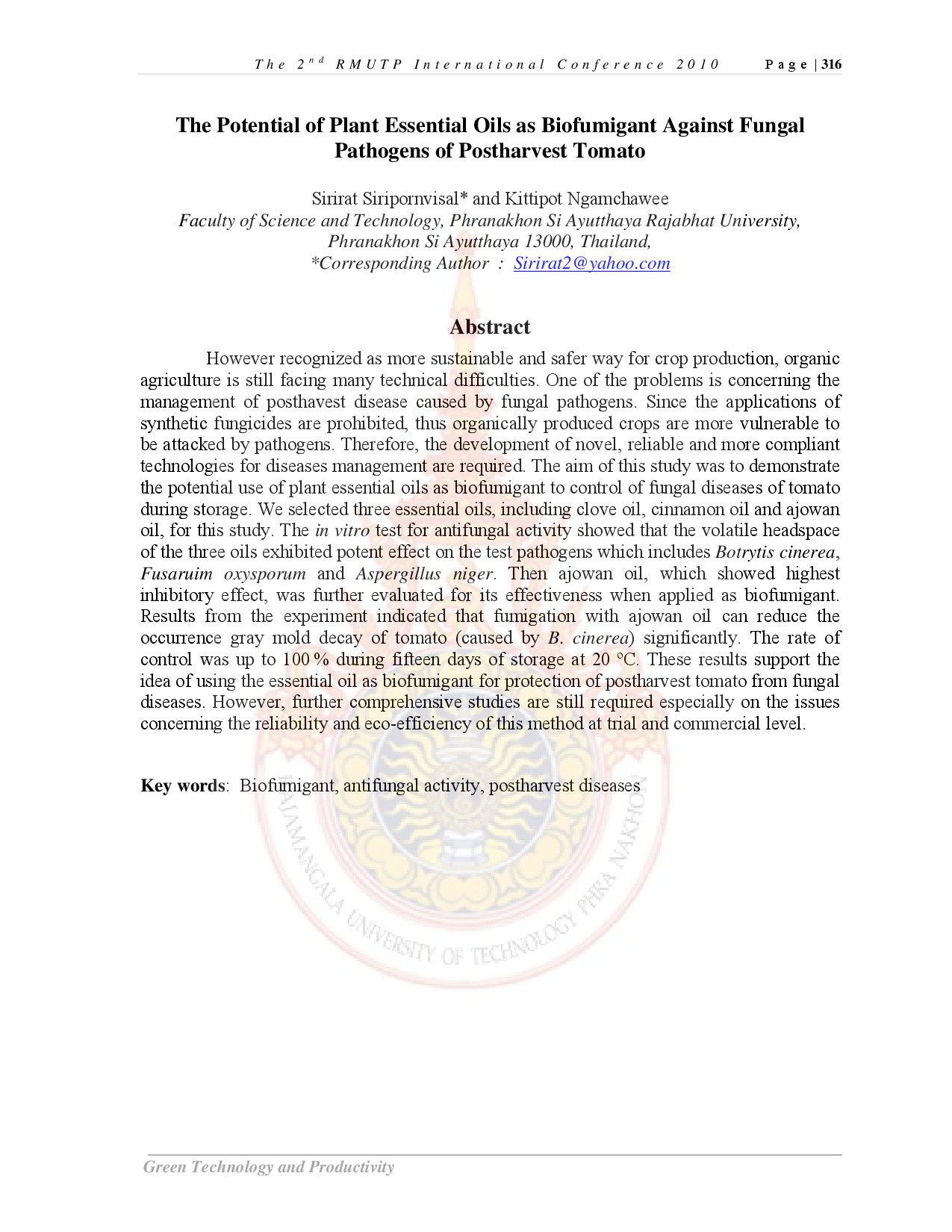
The Potential of Plant Essential Oils as Biofumigant Agains Fungal Pathogens of Postharvest Tomato
However recognized as more sustainable and safer way for crop production organic agriculture is still facing many technical difficulties. One of the problems is concerning the management of posthavest disease caused by fungal pathogens. Since the applications of synthetic fungicides are prohibited thus organically produced crops are more vulnerable to be attacked by pathogens. Therefore the development of novel reliable and more compliant technologies for diseases management are required. The aim of this study was to demonstrate the potential use of plant essential oils as biofumigant to control of fungal diseases of tomato during storage. We selected three essential oils including clove oil cinnamon oil and ajowan oil for this study. The in vitro test for antifungal activity showed that the volatile headspace of the three oils exhibited potent effect on the test pathogens which includes Botrytis cinerea Fusaruim oxysporum and Aspergillus niger. Then ajowan oil which showed highest inhibitory effect was further evaluated for its effectiveness when applied as biofumigant. Results from the experiment indicated that fumigation with ajowan oil can reduce the occurrence gray mold decay of tomato (caused by B. cinerea) significantly. The rate of control was up to 100 % during fifteen days of storage at 20 ºC. These results support the idea of using the essential oil as biofumigant for protection of postharvest tomato from fungal diseases. However further comprehensive studies are still required especially on the issues concerning the reliability and eco-efficiency of this method at trial and commercial level.
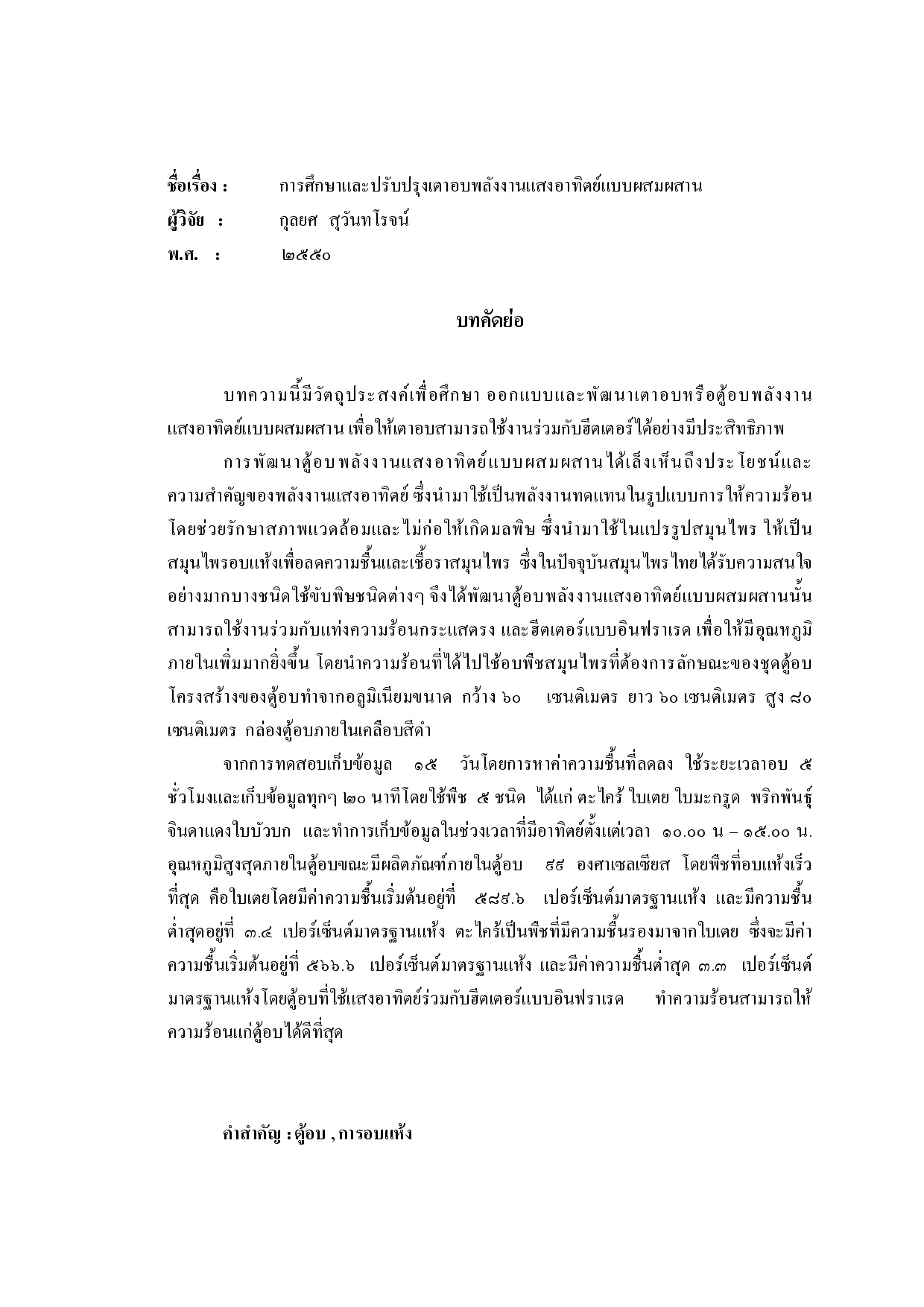
A Study and Development of Solar Hybrid Energy Oven
The objective of this paper is to design and develope solar hybrid oven for common usage heat energy between sunshine and heater. The technology improvement of integrated solar dryer cabinet aims to prove that the solar energy for thermal purpose is the most useful alternative device for energy conservation which helps environment and pollution protection. It can also be an effective equipment for industrial drying process of herbal plants and products in term of dehydration humidity reduction and fungus termination. The use of solar dryer cabinet can serve the high demand in the market of Thai herbal products which some of which are also used as detoxification. Solar Hybrid Energy Oven choose between infrared heater and DC heater. The outer structure of solar drying cabinet is made of aluminum sheet of 60 cm. wide 60 cm. long and 80 cm. high. The inner box is coated with black paint. The experimental process and data collection of solar radiation was carried out for 15 days. The humidity value measurement was conducted during a 5-hour drying process with data collection at every 20 minutes. The herbal plants used in the experiment are lemongrass pandanus citrus hystrix leaf red paprika and gotu kola. The data collection hours are from 10.00 am to 15.00 pm and the finding shows that the highest temperature in the cabinet reaches 99 degree Celsius . The fastest dehydrated and dried plant is pandanus whose initial humidity value is 589.6 % dry basis and humidity mean after drying process is 3.4 % dry basis. Lemongrass contains the second highest initial humidity value which is 566.6 % and humidity mean after drying process is 3.3 % dry basis .This indication confirms that the technology of solar energy combined with infrared heater can most effectively generate the heat in the cabinet to serve the drying process.

Technology Transfer on Construction and Charcoal Burning Technique from 200 Liters Charcoal Kiln
Traditional charcoal burning of rural people used husk kiln which had to use big piece of wood and get low quality charcoal. The objectives of this technology transfer were to provide training about 200 liters charcoal kiln invention and teach charcoal burning technique to villager in Tongfa district amphur Bantak Tak province. In the project materials that were used to build the kiln were given to 30 people in the village. The project had been separated in three phases preparing training and project evaluation. In training phase the villager was divided in 5 groups and all group used branches of eucalyptus that had the same sizes. The results of practical training were found that the best group got charcoal 0.75 sack and eucalyptus vinegar 2.3 liters by using 7.33 hours. After training questionnaire was used to evaluate satisfaction of participants. The statistical analysis results showed that Mean (x#) was 4.69. In the part of the success of the project it was found that found that participant could apply the khowledge the most. 58.06% of participant increased income 1001-2000 baht per month.