จำนวน Repository ( 3611 )
Optimization of Infrared Radiation Heating in Disinfestations of Organic Hom Mali Rice
There is a difficulty in using chemical in disinfestations process in organic rice products therefore this research was aimed to study the optimal setting of infrared radiation heating for disinfestations in Organic Hom Mali Rice. Disinfestations process and rice storage were collected by surveying coupled with interviewing the rice milling enterprise. The infrared radiation heating used in this experiment was belt type with lamp power of 1000 watt. In this study Design of experimental technique was applied to generate the optimum setting of the infrared heating process. The experiments generated by Box Behnken design were 15 experiments and 2 replicate times therefore the total experiments were 30 times. The 3 factors include heating temperature gap between rice and infrared lamp and rice layer thickness. The result from statistical data analysis at reliability level of 95 % shown that the optimization value were heating temperature of 70 oC height of lamp above rice of 10 cm. and rice thickness of 0.5 cm insects mortality rate within 2-3 minutes. Rice after heating were subjected to naturally slow cooling by air therefore rice quality in a good condition without broken or cracking.
Investigated on Removal of Residual Dyestuff in Effluent from Dyeing Process: Physical Method
This study was investigated the pretreatment of dye effluent from dyeing process by activated carbon. The study parameters were color strength operating time and types of dyestuff such as direct dye reactive dye acid dye basic dye and disperse dye. The results found the activated carbon was achieved to adsorb the colorant. The pretreatment process used 100 – 200 gram activated carbon to one liter of dye effluent. The contact time was 2 hours at room temperature. The dyeing conditions had an influent for pretreatment process. The acidic condition was favored than neutral and basic condition. In addition the dye removal efficiency was basic dye > acid dye > disperse dye > direct dye > reactive dye.
A Study value added for increase valued the Anti–insect Cloth Hanger Product Cast Study : Bansaphatana Group Cluster
The main objective of this research has to study the production process and the production development of a community business. In the case of Bansaphatana network enterprise study in the part of products form and duty function for increase the product value and response to customer demand by using the application of engineering value plans in seven(7) steps of A.E.Mudge. This in proceeding implementation was beginning from 1) do the data collects and data analyses by prominent point comparison (strength and weakness point of product) the defect of clothes hanger each kind products in each. 2) Use engineering worth technique in 3) analysis’s brainstorm 4) assess for seeking the trend to increase product value of anti-insect cloth hanger. Which the result get from this research has done products development and the procedure produce form as distinctly divided into male and female a way to create product identity and enhance usability duty of the clothes hanger. It could be usage the hang clothes in diverse way such as trousers skirt one stripe blouse etc. It’s build hook product there’s strength durability. From the result’s assessment compares with before and after the conduct of this research found that total investment increased from 15.93 baht to 20.93 baht Which compose the costs of raw materials from 11.93 baht to 14.43 baht and labor capital increases from 4.00 baht to 6.50 baht. While wholesale price increased from 30 baht to 45 baht thus make the profit increases from 9.07 baht to 14.07 baht per piece Can be think the difference profit rate of the products 1 piece be 10.28%.
The Development of New Mixed Fiber from Waste Cocoon and Other Plant Fibers
The purpose of this research was to develop new mixed fiber from waste cocoon and other plant fibers. It was found that waste cocoon has qualitative properties to produce new mixed fiber when mixed with five kinds of plant fibers namely cotton yarn linen yarn pineapple yarn ramie yarn and hemp yarn. The processes included boiling waste cocoon in wetting agent water and Sodium Carbonate for 30 minutes at 90 ºC and dehydrating it. After that short cocoon yarn was obtained. Then mix it with the five kinds of plant fibers with the ratio of 50:50 in carding at silk card and undergo mixing and spinning process. Qualitative test result of new mixed fiber from waste cocoon used as weft yarn and five kinds of plant fibers used as warp yarn in industrial weaving showed that fiber from waste cocoon mixed with hemp yarn has the best breaking strength of 194 CN/tex followed by waste cocoon mixed with ramie yarn of 149 CN/tex waste cocoon mixed with linen yarn of 146 CN/tex waste cocoon mixed with pineapple yarn of 145 CN/tex and waste cocoon mixed with cotton yarn of 143 CN/tex. Meanwhile fiber from waste cocoon mixed with heft yarn has the best mean elongation of 2.30 cm followed by waste cocoon mixed with cotton yarn of 2.32 cm waste cocoon mixed with ramie yarn of 2.77 cm waste cocoon mixed with linen yarn of 3.42 cm. and waste cocoon mixed with pineapple yarn of 3.43 cm. Thus the research results indicated that fiber from waste cocoon mixed with hemp yarn is good for producing home textile as it has the highest breaking strength while fiber from waste cocoon mixed with pineapple yarn is good for producing clothes.
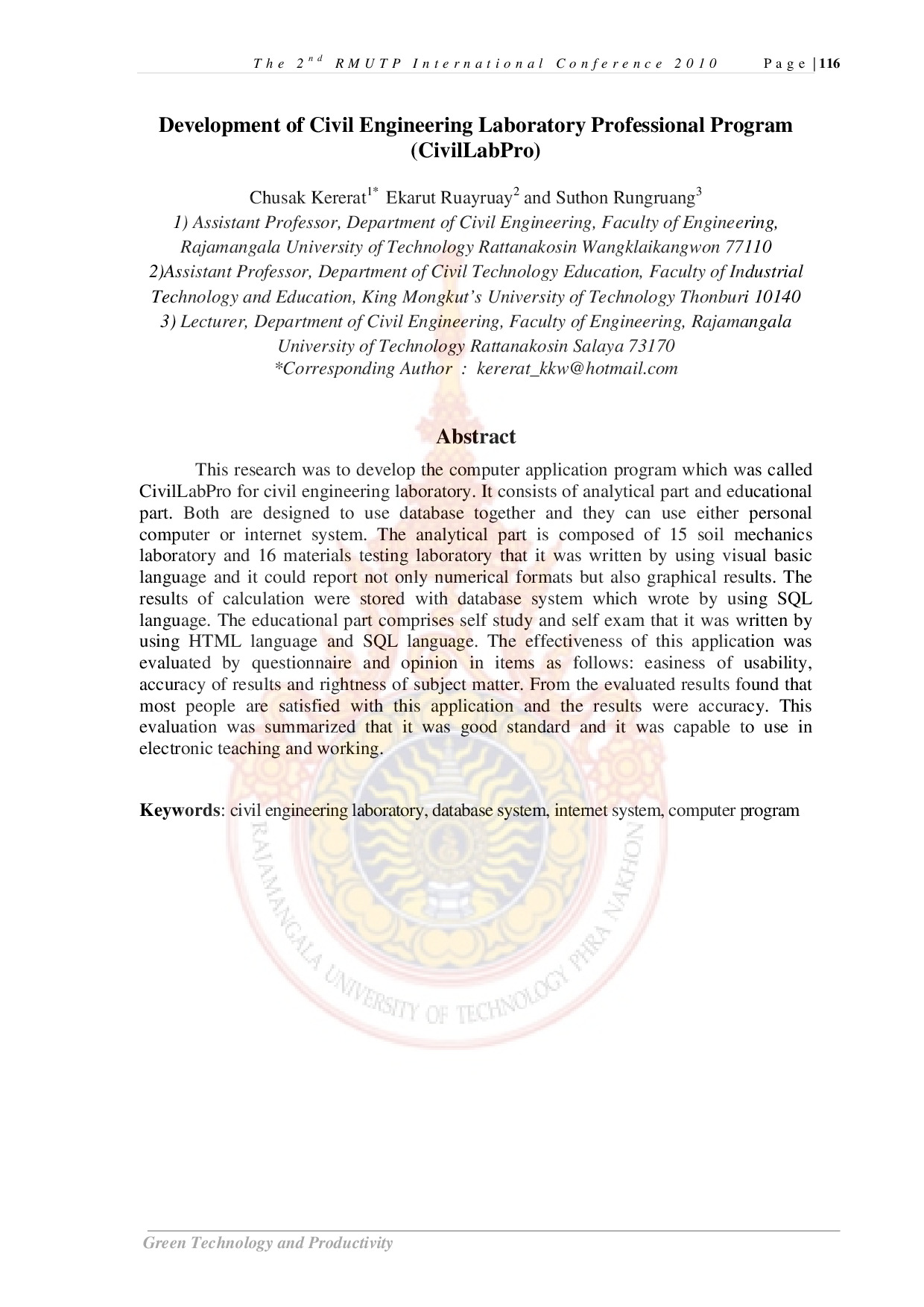
Development of Civil Engineering Laboratory Professional Program (CivilLabPro)
This research was to develop the computer application program which was called CivilLabPro for civil engineering laboratory. It consists of analytical part and educational part. Both are designed to use database together and they can use either personal computer or internet system. The analytical part is composed of 15 soil mechanics laboratory and 16 materials testing laboratory that it was written by using visual basic language and it could report not only numerical formats but also graphical results. The results of calculation were stored with database system which wrote by using SQL language. The educational part comprises self study and self exam that it was written by using HTML language and SQL language. The effectiveness of this application was evaluated by questionnaire and opinion in items as follows: easiness of usability accuracy of results and rightness of subject matter. From the evaluated results found that most people are satisfied with this application and the results were accuracy. This evaluation was summarized that it was good standard and it was capable to use in electronic teaching and working.