จำนวน Repository ( 3611 )
The Development for Product of Local Folk-weaving Material by the Weaving Group of Paihoochang Banglen, District, Nakhon Pathom Province
The objective of the study was to examine the opinions toward 5 products made of local folk material Paihoochang Banglen district Nakhon Pathom Province which were facial tissue boxes hanging hand towels bolster cushions bags tablecloths and to study the basic background of the customers who appreciated with handicraft. The research considered the styles sizes practical uses and attractiveness on different products. The 200 evaluators were accidentally sample from those interested in model handicraft presented in 4 department stores of Nakhon Pathom. The statistic analysis was done by using the computer program. The finding indicated that most of the evaluators were female who were about 31 – 40 years of age single and graduated in Bachelor degree level. Their occupations were running private business with over 20000 baht income per month. The purpose for buying products was the souvenirs. The motivation for buying was the practical use. The result of customer satisfaction affected handicraft product from local folk weaving showed that the average highest satisfaction in styles of product was the hanging hand towels B. The satisfaction of sizes of product showed the average highest were the hanging hand towels A B. The satisfaction of practical use of product showed the average highest was the hanging hand towels A.
The Development of Fancy Yarn from Banana and Cotton Fiber Blend
The research of development Fancy yarn from Banana fiber and cotton fiber blend was conducted to seek Ratio of Banana fiber and cotton fiber for making sliver by ROLLER CARD. It was found that blending banana fiber and cotton fiber at 20: 30 30: 40 40: 60 and 50: 50 was able to be spun as sliver. Due to the quantity of Banana fiber there were quantity of yarn less than or equal with cotton fiber it made both fibers cling together. In the parts of the suitable sliver laying direction to contain to the GAREBO YARN TUBE was found that the suitable laying direction to contain into the GAREBO YARN TUBE could make sliver easily draw and continue spinning yarn. About Ratio and weight of sliver in GAREBO YARN TUBE that was affect to Fancy yarn spinning as SLUB YARN was found that the qualification of thread for seeking yarn twist yarn strength and Elongation (Percentage) of Banana Fiber : cotton Fiber 20:80 was found that the weight of Sliver 20 grams have yarn twist (turn/inches) mean 10.8 (newton) of sliver 40 grams mean 6.27 and Elongation (Percentage) of sliver 30 grams mean 4.45. Banana Fiber : cotton Fiber 30:70 was found that the weight of Sliver 30 grams have yarn twist (turn/inches) mean 10.9 (newton) of sliver 30 grams mean 7.68 and Elongation (Percentage) of sliver 30 grams mean 4.93. Banana Fiber : cotton Fiber 40:60 was found that the weight of Sliver 40 grams have yarn twist (turn/inches) mean 10.5 (newton) of sliver 20 grams mean 6.20 and Elongation (Percentage) of sliver 40 grams mean 4.76. Banana Fiber : cotton Fiber 50:50 was found that the weight of Sliver 20 and 40 grams have yarn twist (turn/inches) mean 10.9 (newton) of sliver 30 grams mean 6.07 and Elongation (Percentage) of sliver 20 grams mean 5.09. Banana Fiber : cotton Fiber 60:40 was found that the weight of Sliver 20 grams have yarn twist (turn/inches) mean 11.2 (newton) of sliver 40 grams mean 5.34 and Elongation (Percentage) of sliver 40 grams mean 4.57.
The Development of Mudmee Pattern : The Case Study of Silhouette of Prasat Si Khoraphum Using in Clothing Design
The aims of this study are as follows 1.) to develop a new woven Mud Mee pattern which inspired by optical art integrated with the silhouette of Prasat Si Khoraphom in Surin province 2.) to use the developed Mud Mee pattern to improve clothing design influenced from 1960s fashion 3.) to test the satisfaction level of the finished Mud Mee clothes from the sample group. There are 7 textile professionals including pattern designers textile artists Mud Mee textile specialists and 4 fashion designers as supervisors in screening the patterns and designs. The sample group was selected from the staffs who work in Rajaphat Surindra University and Rajamangala University of Technology Northeast (Surin Campus). The tools used in this research were the fabric pattern sketches inspired by optical art integrated with the silhouette of Prasat Si Khoraphum the 1960 fashion clothing design sketches and the satisfaction survey. The statistical package for the social science program was used to find mean and percentage. This study found that the most selected designs from 7 textile professionals were Pra Sart Moom Soong pattern Phasom Phasarn Nammatam pattern and Barai Sai Nam pattern. There were 9 jacket sketches that had been selected. The level of satisfaction on the clothing design from 1960 era of 213 women staff who work in Rajabhat Surindra University and Rajamangala University of Technology Northeast (Surin Campus) showed that the Phrasat Moom Soong pattern gained the highest level of satisfaction (4.78) The Barai Sainam pattern was the most aesthetics pattern (4.70). Finally the sample group satisfied the color and pattern of Phasom Phasan Nammatham the most (4.73). In Chon-Phoa group the most aesthetic jacket patterns were Phrasat Moom Soong (4.67) and Phasom Phasrn Nammatham(4.70). While the Bari Sainam pattern appeared to have the highest level of correlation between pattern and clothing design (4.74). In the uniform group the most aesthetic 1960 jacket patterns were Phrasat Moom Soong (4.74) and Phasom Phasrn Nammatham(4.71). While the Bari Sainam pattern appeared to has the highest level of correlation between pattern and clothing design (4.73). In Art and Fashion group highest level of correlation between pattern and clothing designs for each pattern were Phrasat Moom Soong pattern (4.67) Bari Sainam pattern (4.69) and Phasom Phasrn Nammatham (4.70).
Development of Thai Style Handmade Paper from Sugar Cane Leaves for Handicraft and Package
The objectives of this work are to develop the technique of making paper from sugar cane leaves to make the prototype products made from the developed paper and then transfer the technology to the selected groups. The study included 5 steps: (1) select the target group of 60 people from sugar cane farmers community enterprise group and general public in Lopburi province (2) make the prototype products and present to public (3) prepare the tools for transferring the technology (4) transfer the developed technology and (5) evaluation and statistical analysis including frequency percentage mean and standard deviation. The general information of the 60 trained people can be summarized as follows: 80.00 % is female 26.67 % is 31-40 years old and 40.00 % is sugar cane farmer. The objectives content activities and training method were evaluated to be the best suitable. The structure of the course was found to be the most suitable. More over the materials training documents and place were rated to be the most suitable to the best suitable.
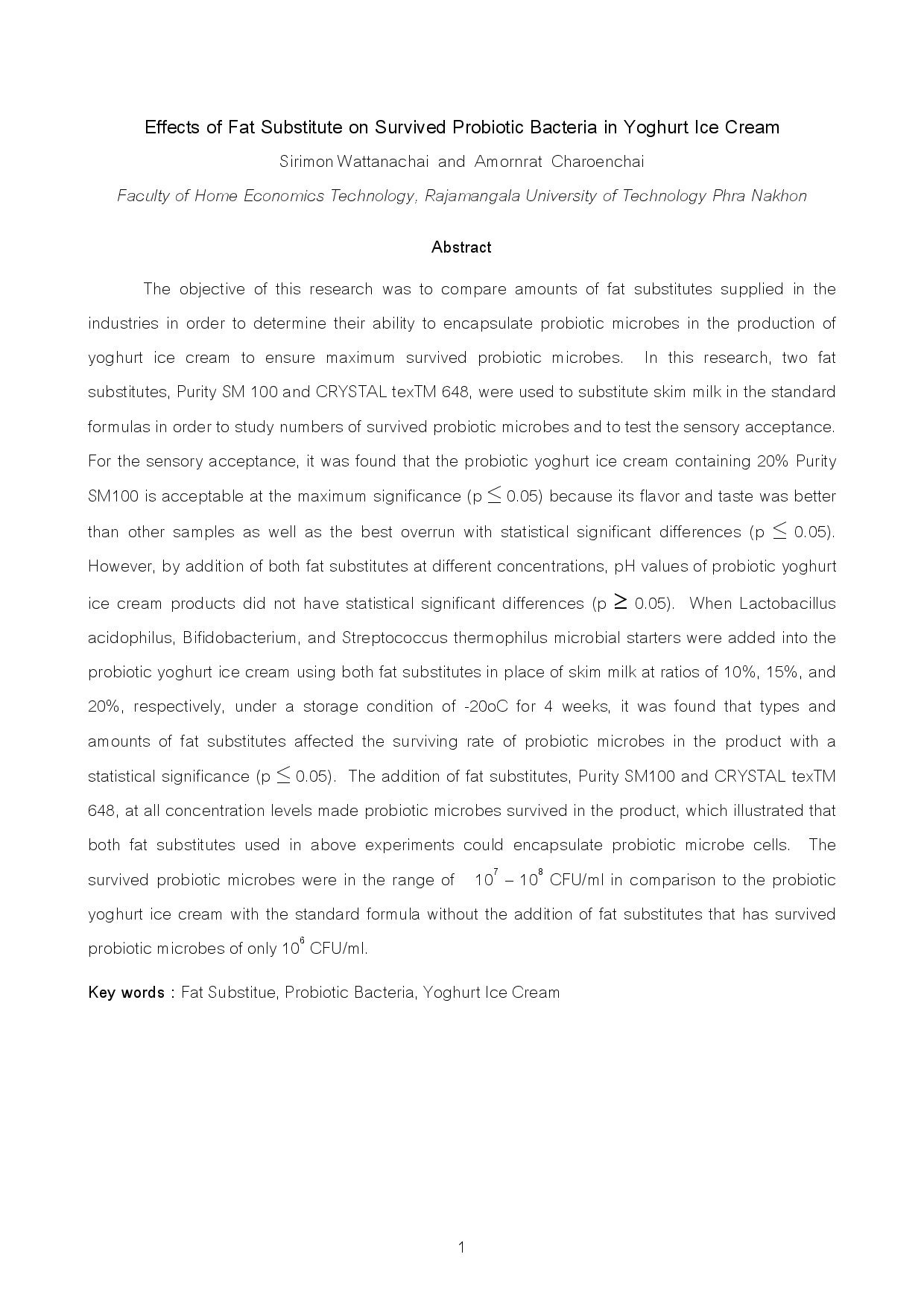
Effects of Fat Substitute on Survived Probiotic Bacteria in Yoghurt Ice Cream
The objective of this research was to compare amounts of fat substitutes supplied in the industries in order to determine their ability to encapsulate probiotic microbes in the production of yoghurt ice cream to ensure maximum survived probiotic microbes. In this research two fat substitutes Purity SM 100 and CRYSTAL texTM 648 were used to substitute skim milk in the standard formulas in order to study numbers of survived probiotic microbes and to test the sensory acceptance. For the sensory acceptance it was found that the probiotic yoghurt ice cream containing 20% Purity SM100 is acceptable at the maximum significance (p ≤ 0.05) because its flavor and taste was better than other samples as well as the best overrun with statistical significant differences (p ≤ 0.05). However by addition of both fat substitutes at different concentrations pH values of probiotic yoghurt ice cream products did not have statistical significant differences (p ≥ 0.05). When Lactobacillus acidophilus Bifidobacterium and Streptococcus thermophilus microbial starters were added into the probiotic yoghurt ice cream using both fat substitutes in place of skim milk at ratios of 10% 15% and 20% respectively under a storage condition of -20oC for 4 weeks it was found that types and amounts of fat substitutes affected the surviving rate of probiotic microbes in the product with a statistical significance (p ≤ 0.05). The addition of fat substitutes Purity SM100 and CRYSTAL texTM 648 at all concentration levels made probiotic microbes survived in the product which illustrated that both fat substitutes used in above experiments could encapsulate probiotic microbe cells. The survived probiotic microbes were in the range of 107 – 108 CFU/ml in comparison to the probiotic yoghurt ice cream with the standard formula without the addition of fat substitutes that has survived probiotic microbes of only 106 CFU/ml.