จำนวน Repository ( 3611 )
การพัฒนาผลิตภัณฑ์กระดาษและบรรจุภัณฑ์จากแกลบ และส่วนเหลือทิ้งในการแปรรูปข้าว เพื่ออนุรักษ์ศิลปไทย
This research is a study on the Development of Paper and Packaging from Rice Husk and Rice Processing Wastes for producing for Thai Art Conservation. This research purpose to develop products and packaging from the rice husk in rice processing to study the processes of paper production and forming products to design and develop products and packaging and to transfer technology products and packaging from the leftovers in rice processing to conserve Thai arts to the community and to study the satisfaction of the product and packaging development program from the leftovers in rice processing in order to conserve Thai arts to the community. The research findings can be summarized as follows: 1. In this research the research team produced paper and molded products experimenting with the ratio of RICE HUSK and paper SA fibers and find the best ratio of rice husk 50: paper SA fibers 50 so that rice husk can better adhere to paper and creates a beautiful texture for making products. Moreover this research uses the waste from the rice processing process it able to develop products according to objectives. At the same time can be produced at the household level. As well as finding marketing methods for new products to be able to sell which generates income for the community. 2. The results of the physical characteristics of paper produced from rice husk paper with the ratio of rice husk 50 to 50 has a moderate weight. The paper can be folded. The tensile strength of the paper is moderate. The surface is good. The characteristics of the paper after coated with waterproofing it was coated with natural extracts and environmentally friendly. When testing the water color paint on paper the water color slowly absorbed but does not spread along the paper fibers and also slightly absorbed in the backside paper. 3. In this research the development of products and packaging from the leftovers in rice processing for preserving Thai art into 2 categories 1. Develop paper from rice husk for processing into products and developing molded products from rice husk consisting of 3 sets of ornaments consisting of necklaces bracelets earrings 4 sets of home decor consisting of pans wall paintings and 3 sets of household items consisting of 4 multipurpose boxes fruit trays altar table 4. The knowledge transfer by organizing a workshop for theoretical and practical work the duration of knowledge transfer was 2 days 50 participants between 11 - 12 august 2019 at Bang Tachong Community Enterprise Village No.8 Tha Ngam Subdistrict and District in Buri Sing Buri province. Most participants are satisfied with the highest levels in all questions.

การศึกษาความรู้และทัศนคติของนักศึกษาคณะเทคโนโลยีคหกรรมศาสตร์ มหาวิทยาลัยเทคโนโลยีราชมงคลพระนครที่มีต่อฉลากโภชนาการตามแบบจีดีเอ
The purposes of this research were : 1) A study of knowledge about the nutrition labeling formats GDA of Faculty of Home Economics Technology Rajamangala University of Technology Phra Nakhon Students 2) A study of attitude towards the nutrition labeling formats GDA of Faculty of Home Economics Technology Rajamangala University of Technology Phra Nakhon Students 3) Compare knowledge about the nutrition labeling formats GDA Classified by gender years of study and majors and 4) Compare attitude towards the nutrition labeling formats GDA Classified by gender years of study and majors. The sample were 307 first year to fourth year. The instrument was a questionnaire. Frequency percentage mean standard deviation t-test ANOVA and Duncan’s Multiple Range Test were used in data analysis via computer program. The results showed that : 1) The most students have moderate level of knowledge and understanding 2) Students have a high level of attitudes when considering each item it was found that the items with the highest mean were: The GDA nutrition label is beneficial to everyone 3) Compare knowledge about the nutrition labeling formats GDA of Faculty of Home Economics Technology Rajamangala University of Technology Phra Nakhon Students Classified by gender years of study and majors It was found that students with different levels of education and disciplines had different knowledge about nutritional labels in the GDA except for students with different sex. Knowledge of nutrition labeling according to GDA not different Statistically significant at the .05 level and 4) Compare attitude towards the nutrition labeling formats GDA of Faculty of Home Economics Technology Rajamangala University of Technology Phra Nakhon students classified by gender years of study and majors it was found that students with gender education and different disciplines. Attitude toward nutritional labeling according to GDA not different statistically significant at the .05 level.
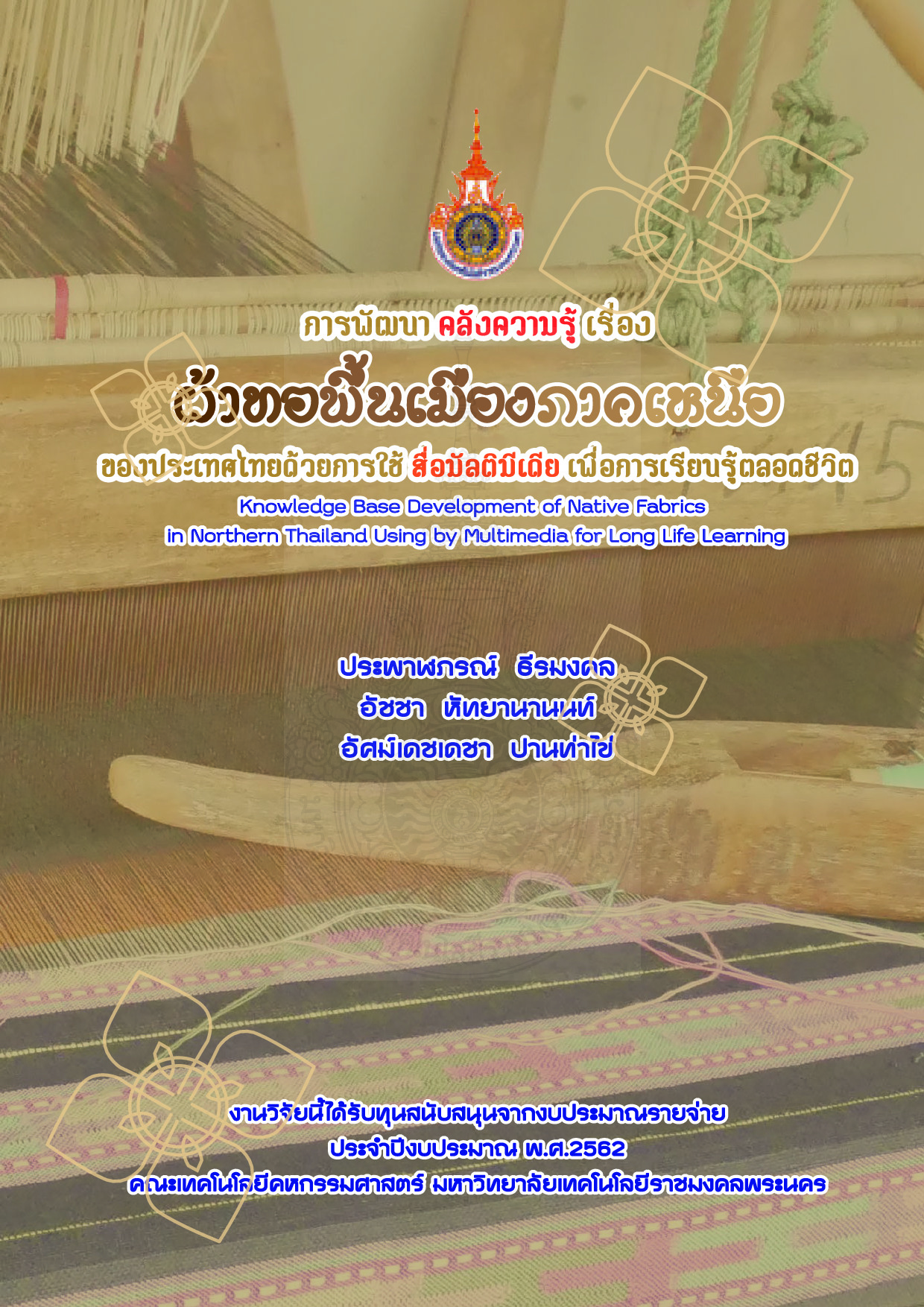
การพัฒนาคลังความรู้เรื่องผ้าทอพื้นเมืองภาคเหนือของ ประเทศไทยด้วย การใช้สื่อมัลติมีเดียเพื่อการเรียนรู้ตลอดชีวิต
This research is the development of the knowledge base on local textiles of northern Thailand by using multimedia for lifelong learning. The aim is to study compile and gather information of local cloths in northern Thailand. Develop a knowledge base by using multimedia on the local textiles of northern Thailand for lifelong learning and transferring knowledge and disseminating the knowledge base on northern Thai fabric by using multimedia for lifelong learning to the community. The research team proceeded to gather primary knowledge from the roots of the researchers who are interested in the local woven fabric. Therefore proceeding further knowledge in the upper reaches from literature reviews Including from field trips for data collection through in-depth interviews with important people Interviewing people who have knowledge about social context community local weaving characteristics weaving characteristics name of pattern type of fabric weaving technique of local textiles in northern Thailand in 9 provinces as well as studying primary data from textbooks textbooks and technical documents and in the internet. Thus the research shown that into 3 parts which are 1. Ethnic groups of Northern Thailand 2. Local woven fabric in northern Thailand and 3. Woven process and pattern. After that the knowledge library was developed by using multimedia on the local textiles of Northern Thailand for lifelong learning. This research can summarize the results in the form of a written description showing that the northern region of Thailand in the past was the Lanna Kingdom area. In the area of Xishuangbanna Before moving to the north of Thailand including the Tai Lue Tai Kheen Thai people Tai Yai people Meng (Mon) Lua people villages scattered throughout the highlands of the Lanna region such as Karen (Pak Kahen M) Mien (Yao) Hmong (Meo) Akha (Akha) Lahu (Mso) Lisu. In addition there are some groups in the Lanna fringe such as Khmu Labri (Tong Lueang). Each ethnic group has its own unique style especially Common skirt Has the same basis with the resin head the resin body and the resin tip but each part is not woven differently Have different colors Some ethnicities have a section called Lep which is the part that the weaver often weaves to keep the thread as for knowledge transfer. The research created a book Local woven cloth consists of videos from local knowledge sources and digital documents and to make the transfer of knowledge more complete Therefore held a forum and exhibition on the topic primary fabric of Lanna Kingdom as a medium for those interested in Local woven fabrics in the Lanna Kingdom of Thailand attended. Exchange ideas from various sources of knowledge from the research. While also receiving multimedia for lifelong learning from the inquiry regarding the satisfaction of the participants. The Keynote speakers are interesting and event condition caused the interest in the knowledge content that used to organize the exhibition. Overall the work is most satisfied.
การใช้โยเกิร์ตและอินนูลินในผลิตภัณฑ์น้ำสลัดสูตรถั่วเหลือง
The use of yogurt and inulin in soybean of salad dressing products had steps to develop as follows 1) Selection of salad dressing products basic formula and physical and chemical test. 2) Developing soybean of salad dressing products by crushed soybeans were used instead of whole eggs and used olive oil instead of vegetable oil. The sensory evaluation was done by means of scoring method which was 9-point Hedonic Scale Test. 3) Using the developed soybean salad dressing in 2) to develop it to soybean mixed yogurt salad dressing by putting yogurt for 5 10 and 15 of formula then study the acceptance by sensory tests. 4) Putting inulin into soybean mixed yogurt salad dressing for 5 10 and 15 of formula then did sensory test It was found that consumers rated the most common sensory attributes was soybean mixed yogurt with inulin salad dressing third formula which was mixed by 15% of yogurt and inulin and found that developed soybean salad dressing had low energy without separation of water and fat the surface is glossy cream. The texture of soybean salad dressing formula was smooth there were bubbles in the salad dressing soy sauce and a mellow taste. Soybean salad dressing had thick texture and aroma. This soy formula had a lot of fiber. This was due to the use of soy substituted for yolks and the use of inulin to replace oil that results to have dietary fiber which helped in the digestive system and is low in fat. In addition the use of inulin also made soybean salad dressing was homogeneous did not separate the layer of water with fat. And adding yogurt with lactic acid bacteria helped digestion and stimulated white blood cells to help prevent the growth of harmful bacteria. It also made strengthens of the immune system.
การศึกษาแนวทางพัฒนาหลักสูตรระยะสั้นด้านอุตสาหกรรมสิ่งทอและแฟชั่น
This research uses quantitative research regulations for its purpose of 1) To study the trend of Potential development and career development in textiles and fashion . 2) The development of short-term courses in textiles and fashion it is suitable for the needs of entrepreneurs and the general public. 3) To guide for organizing short-term courses effective in textiles and fashion for making money to the university. Is focusing on the development of short-term course of textiles industry and fashion. There are 2 sample groups Such as entrepreneurs and workers in textiles and fashion industry. The instrument used in the study are questionnaires requirements for the development of textiles industrial and fashion personnel. The aim for study is respondents information training needs to develop the potential of textiles and fashion personnel and the factors influencing the selection of the service short-term course.