จำนวน Repository ( 3611 )
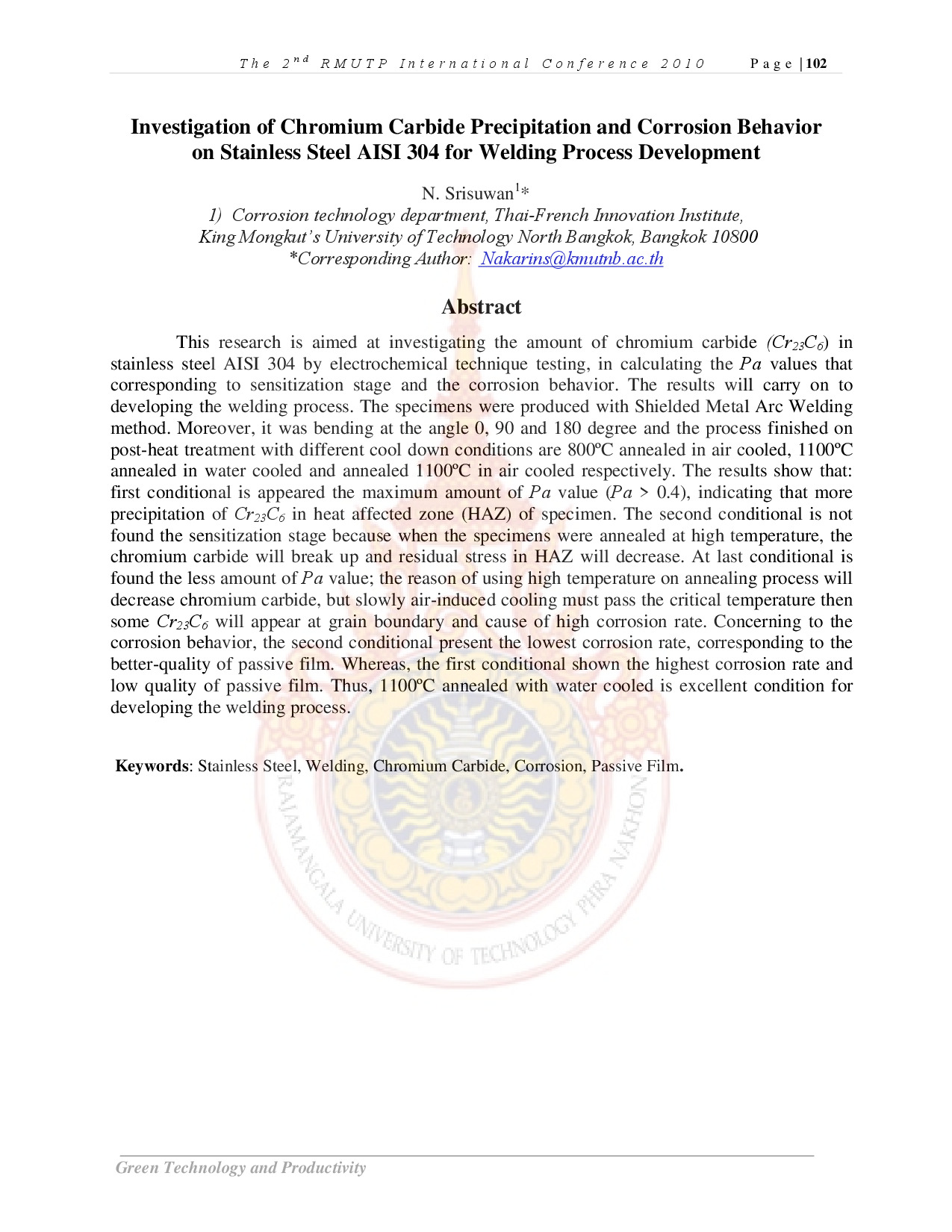
Investigation of Chromium Carbide Precipitation and Corrosion Behavior on Stainless Steel AISI 304 for Welding Process Development
This research is aimed at investigating the amount of chromium carbide (Cr23C6) in stainless steel AISI 304 by electrochemical technique testing in calculating the Pa values that corresponding to sensitization stage and the corrosion behavior. The results will carry on to developing the welding process. The specimens were produced with Shielded Metal Arc Welding method. Moreover it was bending at the angle 0 90 and 180 degree and the process finished on post-heat treatment with different cool down conditions are 800ºC annealed in air cooled 1100ºC annealed in water cooled and annealed 1100ºC in air cooled respectively. The results show that: first conditional is appeared the maximum amount of Pa value (Pa > 0.4) indicating that more precipitation of Cr23C6 in heat affected zone (HAZ) of specimen. The second conditional is not found the sensitization stage because when the specimens were annealed at high temperature the chromium carbide will break up and residual stress in HAZ will decrease. At last conditional is found the less amount of Pa value; the reason of using high temperature on annealing process will decrease chromium carbide but slowly air-induced cooling must pass the critical temperature then some Cr23C6 will appear at grain boundary and cause of high corrosion rate. Concerning to the corrosion behavior the second conditional present the lowest corrosion rate corresponding to the better-quality of passive film. Whereas the first conditional shown the highest corrosion rate and low quality of passive film. Thus 1100ºC annealed with water cooled is excellent condition for developing the welding process.

The Role of the MAPK Pathways in Response to Ethanol Stress in Saccharomyces cerevisiae
During fermentation process yeast cells are often exposed to ethanol. Although the toxicity of ethanol to budding yeast Saccharomyces cerevisiae has widely been studied the ethanol stress signaling is still unknown. The growth of the mutants lacking genes involved in the mitogen activated protein kinase (MAPK) pathways was examined under ethanol stress condition. Our results revealed that the STE3 and AKR1 genes involved in the pheromone signaling pathway and the BCK1 MPK1 SWI4 SWI6 and MBP1 genes involved in the cell wall integrity pathway were required for tolerance to ethanol. In addition to the mutants of the cell wall integrity pathway the Δste3 and Δakr1 mutants were sensitive to a cell wall perturbing agent calcoflour white suggesting the role of these signaling molecules in maintaining cell wall during ethanol stress.
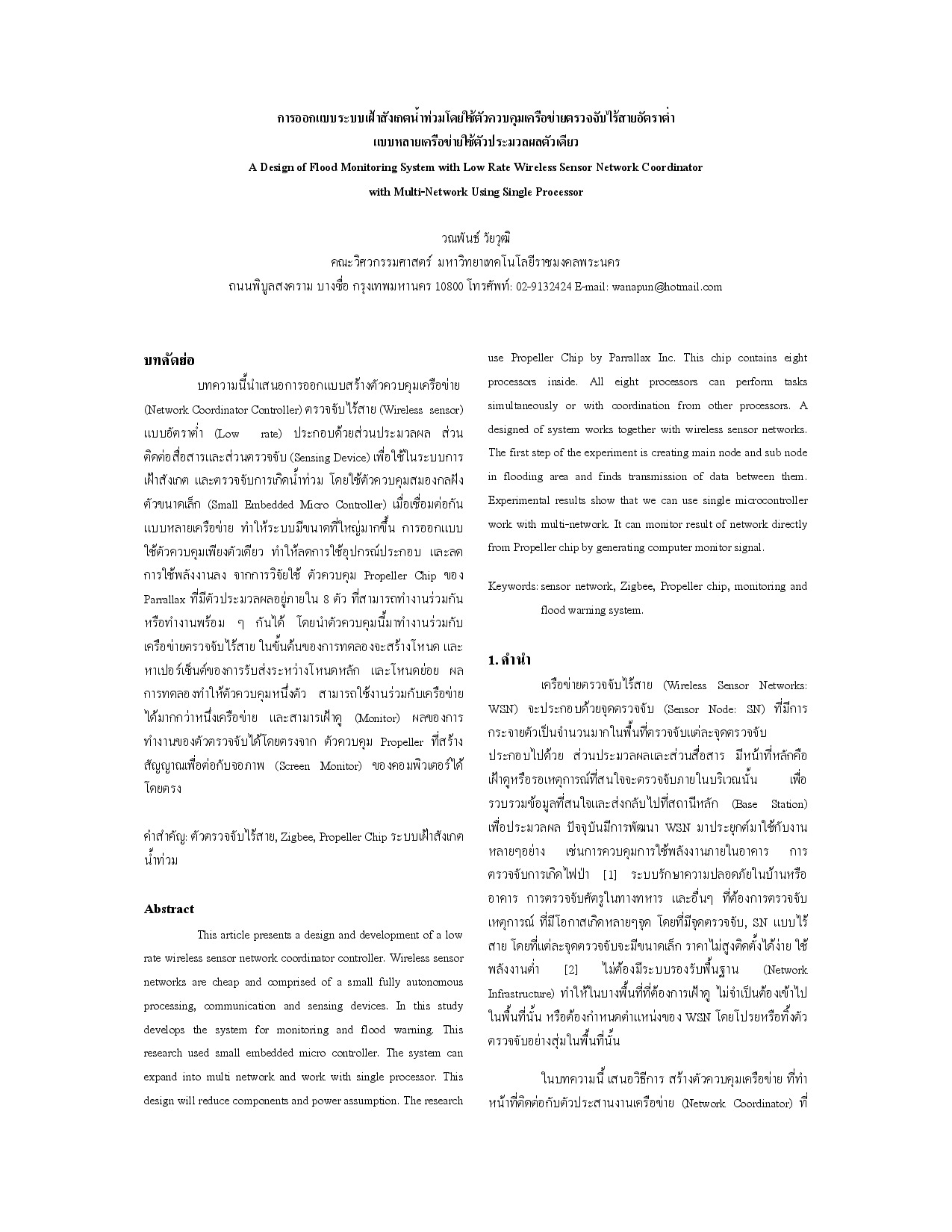
A Design of Flood Monitoring System with Low Rate Wireless Sensor Network Coordinator with Multi-Network Using Single Processor
This article presents a design and development of a low rate wireless sensor network coordinator controller. Wireless sensor networks are cheap and comprised of a small fully autonomous processing communication and sensing devices. In this study develops the system for monitoring and flood warning. This research used small embedded micro controller. The system can expand into multi network and work with single processor. This design will reduce components and power assumption. The research use Propeller Chip by Parrallax Inc. This chip contains eight processors inside. All eight processors can perform tasks simultaneously or with coordination from other processors. A designed of system works together with wireless sensor networks. The first step of the experiment is creating main node and sub node in flooding area and finds transmission of data between them. Experimental results show that we can use single microcontroller work with multi-network. It can monitor result of network directly from Propeller chip by generating computer monitor signal.

Development of Electronic Test to Measure Students’ English Abilities of Rajamangala University of Technology Phra Nakhon
The purposes of this research were to build and develop a standardized test used to measure English abilities compliant with the curriculum of the fourth-year students of Rajamangala University of Technology Phra Nakhon. There were two groups of the students namely the first group which consisted of 57 students who took the traditional pilot paper test and the latter which consisted of 63 students taking the electronic test via the Internet. The other purposes were to find out the students/users’ attitudes and satisfaction towards the use of the electronic test and to obtain a computer program prototype for measuring English abilities. The results were as follows: 1. The item analysis of the pilot paper test revealed that there were 64 items of appropriate difficulty index and discrimination power whereas that of the electronic test revealed that only 56 items had appropriate difficulty index and discrimination power. Even though the latter test had been improved the accepted items were fewer. This led to the assumption that the characteristics of doing an electronic test affected students’ decisions and made them guess more than when they took a paper test. 2. The questionnaires analysis of students’ satisfaction of using the electronic test program to measure their English abilities revealed that the overall arithmetic mean was 75.72. The highest scored item of 87.59 percent was “I think this e-test program is useful”; and the lowest scored item of 66.21 percent was “I think the screen format is interesting”. Moreover there were 11 users who showed their positive opinions towards the e-test program which was 18.97 percent of the latter group.
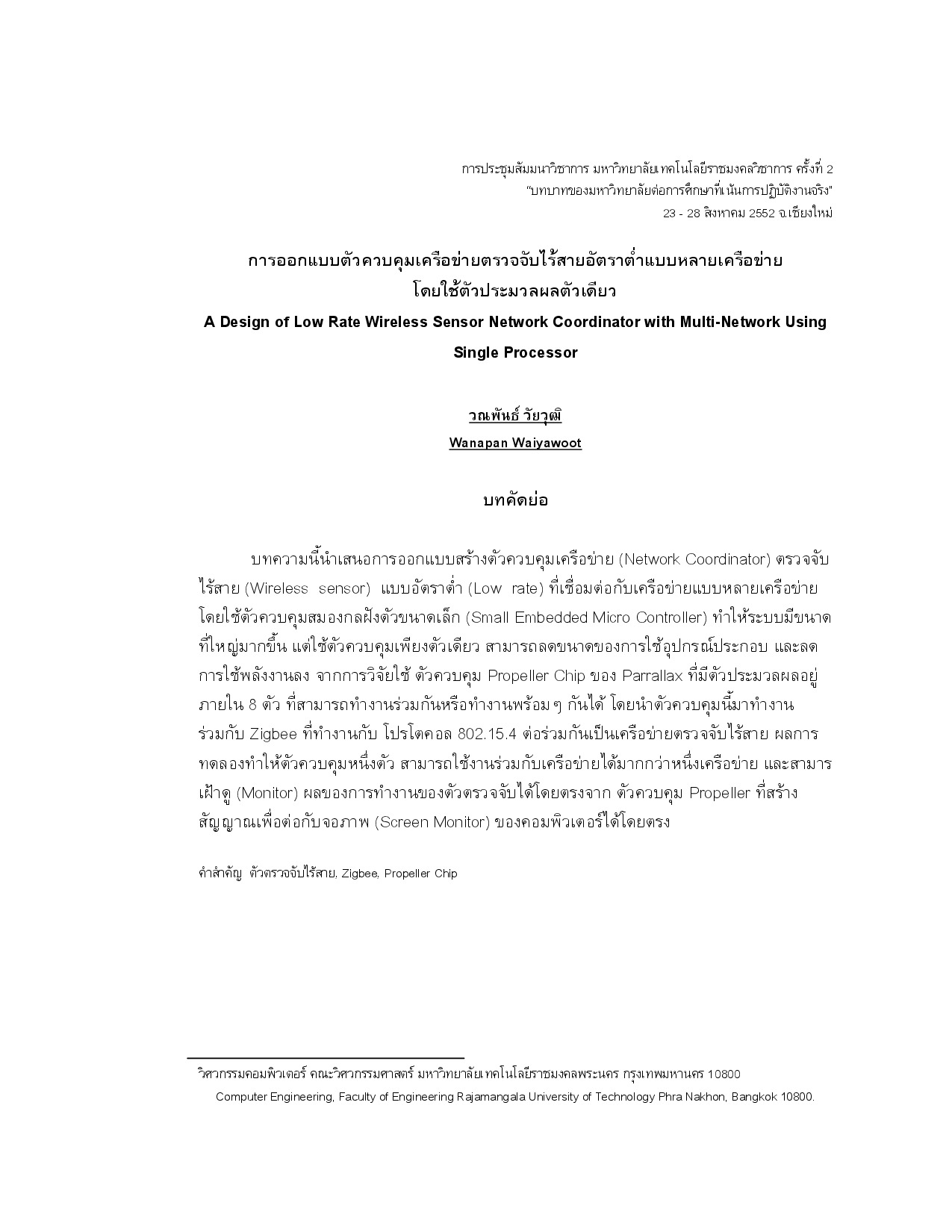
A Design of Low Rate Wireless Sensor Network Coordinator with Multi-Network Using Single Processor
This paper presents the development of a low rate wireless sensor network coordinator with multi-network. This research used small embedded micro controller. The system can expand into multi network and work with single processor. This design will reduce components and power assumption. The research use Propeller Chip by Parrallax Inc. This chip contains eight processors inside. All eight processors can perform tasks simultaneously or with coordination from other processors. It comprised of zigbee chip to perform wireless sensor network that work with 802.15.4 protocol. Experimental results show that we can use single microcontroller work with multi-network. It can monitor result of network directly from Propeller chip by generating computer monitor signal.