จำนวน Repository ( 3611 )
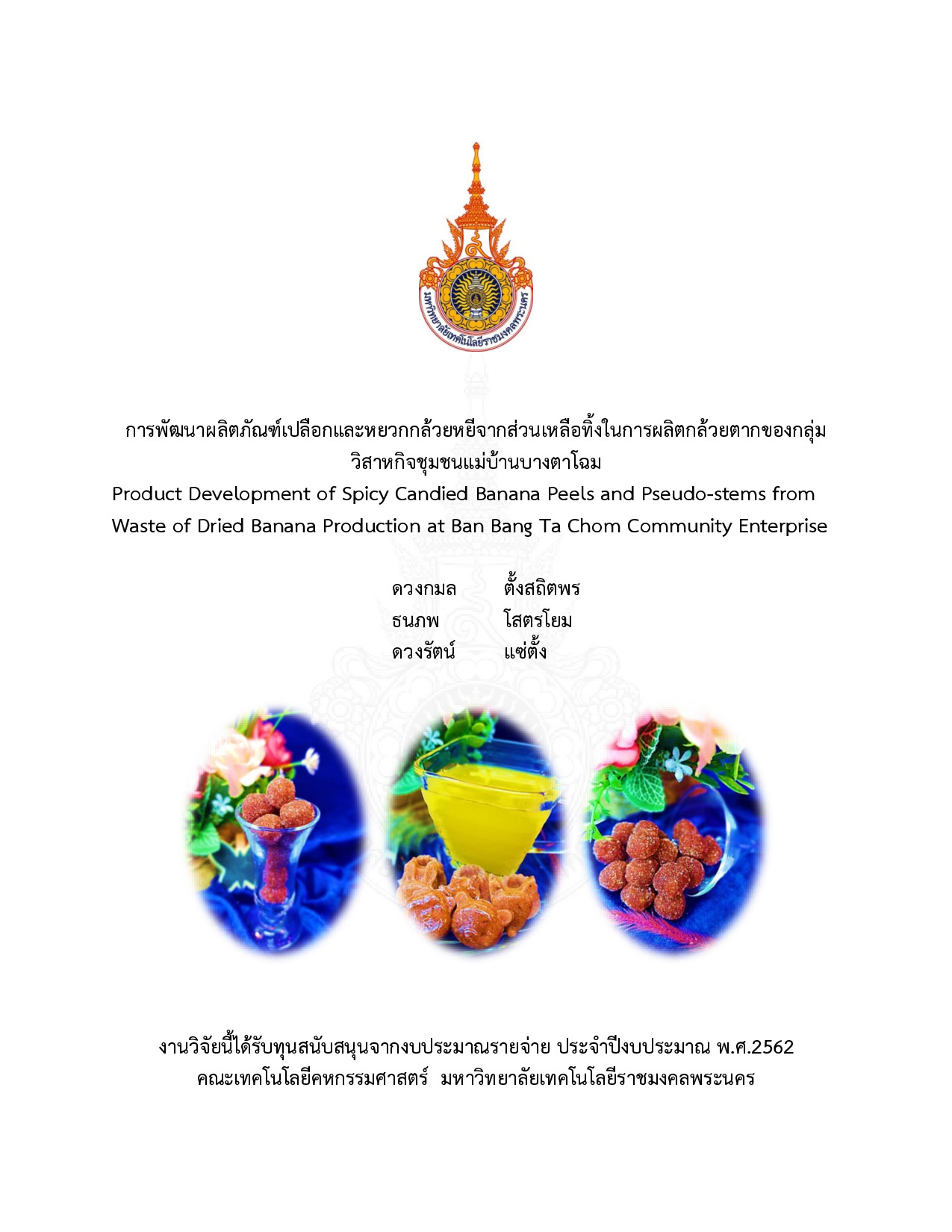
การพัฒนาผลิตภัณฑ์เปลือกและหยวกกล้วยหยีจากส่วนเหลือทิ้งในการผลิตกล้วยตากของกลุ่มวิสาหกิจชุมชนแม่บ้านบางตาโฉม
Product Development of Spicy Candied Banana Peels and Pseudo-stems from Waste of Dried Banana Production at Ban Bang Ta Chom Community Enterprise. The purpose of this study was developing formula and prototype of spicy candied from Banana Peels and Pseudo-stems waste of dried banana production for 3 products such as Banana Peels Spicy Candy Pseudo-stems Spicy Candy and Banana Peels and Pseudo-stems Gummy. The suitable condition for Banana Peels Spicy Candy was using banana peels as 20% after using tamarind sauce as 20% and fructose syrup as 20%. The result of physical analysis showed that : products have brown dark color flavor and taste sour and sweet and chemical analysis Total dietary fiber: TDF = 8.05 g : 100 and Total sugar = 66.82 g : 100 g The suitable condition for Pseudo-stems spicy candy was using Pseudo-stems as 20% after using tamarind sauce as 20% and fructose syrup as 20%. The result of physical analysis showed that : products have brown dark color flavor and taste sour and sweet and chemical analysis Total dietary fiber: TDF = 10.55 g : 100 g and Total sugar = 66.48 g : 100 g The suitable condition for Banana Peels and Pseudo-stems Gummy was using Banana Peels and Pseudo-stems as 15% after using flavored fruit juice as 75% and fructose syrup as 30%. The result of physical analysis showed that : products have brown light color flavor and taste sour and sweet and flexible texture chemical analysis Total dietary fiber: TDF = 18.91 g : 100 g and Total sugar = 40.85 g : 100 g The shelf life of 3 products in vacuum packaging (VP). The result of microorganism analysis less than standard for safe products. The consumer acceptability like extremely product and Interested in buying products.

Experimental investigation of a thermosyphon economizer to recover waste heat in the electronics industry
A case study was conducted to design construct and test a thermosiphon economizer for increasing the temperature of feed water by using waste hot water. The simulation of the thermosiphon economizer (heat exchanger) for the establishment of the optimum size was performed using the thermos-economical method. The thermosyphon was made of a total of 80 copper tubes (outside diam.19.05 mm) with evaporative adiabatic and condensation lengths of 300 10 and 300 mm respectively. The working fluid was R-134a filling ratio was 50% by evaporative volume and the thermosiphon was arranged in a staggered form. In testing performance flow rate of the inlet hot water was set at 10 L/min and the controlled inlet temperature of cold water at 25oC. The average flow rate of the cold water was set at 5 7 and 10 L/min respectively. Results showed that the maximum of rate of heat transfer from the condenser section occurred at the flow rate of the cold water of 10 L/min. When test the inlet temperature of hot water of 4555 and 65 o C were used at the inlet volume flow rate of cold water of 10 L/min maximum heat transfer rates from the condenser 4626 8260 and 8790 W were achieved. Moreover the outlet temperature of the cold water which was initially 25o C changed to 311 34 and 37o C respectively. Therefore increasing the outlet feed water temperature reduced energy consumption. The effectiveness of the thermosiphon economizer with the inlet temperatures of hot water of 45 55 and 65o C was 0.47 0.48 and 0.49 respectively.
การศึกษาพัฒนาเครื่องเชื่อมประสานชิ้นส่วนเครื่องประดับเงินสเตอร์ลิงด้วยระบบอาร์คไฟฟ้า
Case Study Development of Welding Machine for Sterling Silver Jewelry Parts With 500-amp electrical arc system for welding closing porous jewelry after casting. The problem can be solved by welding closing porous or by the jewelry. It is an alternative to repairing the work piece. The efficiency of electrical arc welding equipment can be repaired to a certain extent. Based on the results of the experiments the welding and repairing porous porcelain parts were rated at 500 amperes by random sampling of 4 time slots 5 seconds 10 seconds 15 seconds and 20 seconds. Examine the most appropriate porous or porous workpiece for 20 seconds with 18 complete workpieces capable of sealing or milling. A good percentage of 90 percent of the performance of an electrical arc welding machine for welding sealing or cutting.
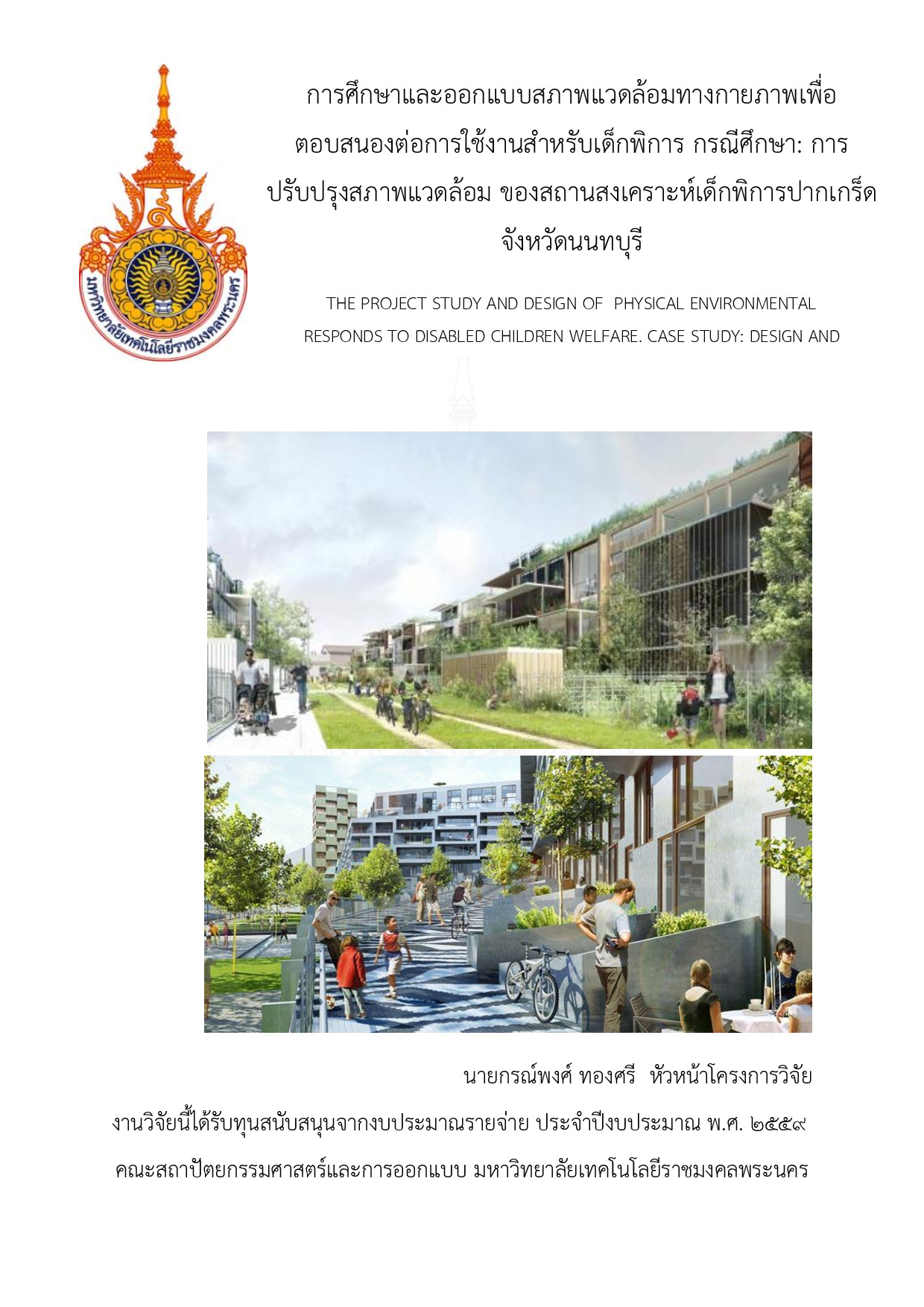
การศึกษาและออกแบบสภาพแวดล้อมทางกายภาพเพื่อตอบสนองต่อการใช้งานสำหรับเด็กพิการ กรณีศึกษา: การปรับปรุงสภาพแวดล้อม ของสถานสงเคราะห์เด็กพิการปากเกร็ด จังหวัดนนทบุรี
This research is the study and design of the physical environment to cater for children with disabilities to use a case study: improving the environment. Children of disabled Pak Nonthaburi study to improve the environment. Children of disabled Pak In order to create jobs and public benefits in the form of a physical environment that is suitable for use for children with disabilities who have a lot of current. The standard test for standards in the design of the physical environment in response to applications for children with disabilities. The study and design of the physical environment of the orphanage for disabled children in Pak Kret. Nonthaburi Interview Design Specialist Concluded in the production and design of the model the researchers examined the experts as appropriate. The researcher has taken the form of physical environment of the area for correction. Then the residents living in the questionnaire about the usage patterns of 200 people which is as follows. The front living An average of 4.85 more convenience average of 4.55 more security average is 4.75 the design average is 4.95 the highest overall satisfaction is at the highest level. Then test the furniture Found that the test kit furniture The tests of static force acting on the seat. And static force acting on the backrest. In the qualifying test. Testing criteria of the static pressure exerted on the cantilever side and the wing stays static head. In the qualifying test. The tests of static force acts pressing down armrest. In the qualifying test. The tests of force exerted on the toggle switch and the force acting on the seat backrest. In the qualifying test. The force exerted on the test criteria. In passing the test Testing criteria regarding the impact on the seat cushion and the armrest. In the qualifying test. Testing criteria for lifting the one side and then released into freedom. In the qualifying test.
Effectiveness investigation of evaporative cooling using radiator for pre-cooling system
Due to the systems of mechanical vapor compression have a high energy consumption for air-conditioned space. Therefore the system of evaporative cooling presents as a promising alternative option for the air-conditioning system. Moreover the pre-cooling system is normally used to reduce an intake ambient air temperature before the air-conditioning system. As mentioned above this research aims to investigate the effectiveness of evaporative cooling system by using a car radiator for air per-cooling. In this research the commercial car radiator was used for cooling inlet ambient air by cooling water. The evaporative cooling system consisted of evaporative cooling panel with a maximum water rate of 40 lite/minute and a maximum air rate of 5100 m3/hr. The results show that most suitable water flow rate of radiator is 10 lite/minute and this radiator can make the differences of air temperature of about 8.9oC. Moreover the results also show that the effectiveness of evaporative cooling system could reach about 73.31% with a maximum sensible heat of 8.43 kW.