จำนวน Repository ( 3611 )

The effect of inlet temperature on the solidification of tubular Ice
This study was aimed to investigate experimental study of the parameters affecting the amount of tubular ice. Significant studied parameters were inlet water temperature. Thickness tendency was increasingly according to time. The thickness of the tubular ice varies with the square root of time according to the theory. At the beginning of the process thickness increased quite fast and decelerated at the end of the production process. The inlet water temperature affected to thickness of tubular ice as the ratio of inlet water temperature to thickness was 0.41 degrees Celsius per millimeter. Thus inlet water temperature affected to thickness of tubular ice according to theoretically results with 342% 43% and 8% error value between ice thickness and production time for 0-10 minutes 11-20 minutes and 21-36 minutes respectively
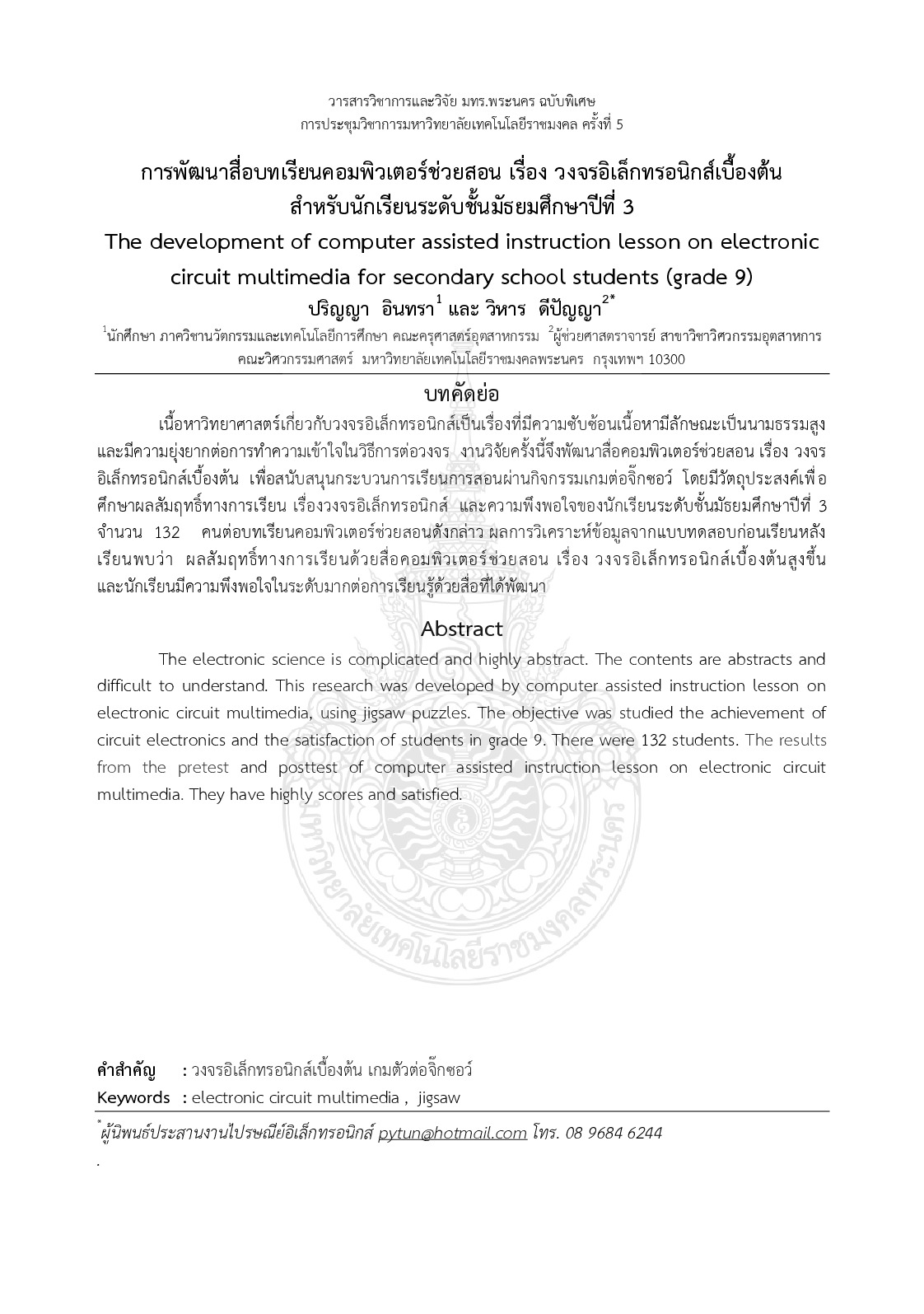
The development of computer assisted instruction lesson on electronic circuit multimedia for secondary school students (grade 9)
The electronic science is complicated and highly abstract. The contents are abstracts and difficult to understand. This research was developed by computer assisted instruction lesson on electronic circuit multimedia using jigsaw puzzles. The objective was studied the achievement of circuit electronics and the satisfaction of students in grade 9. There were 132 students. The results from the pretest and posttest of computer assisted instruction lesson on electronic circuit multimedia. They have highly scores and satisfied.
Factors that alfected the achievement on principle of accounting for basic vocational of Business Admlnistration's student in Rajamangala University of Technology Phra Nakhon
The objective of this research was to investigate the factors that effect the study result of 467 Rajamongala university of Technology Pranakhon students who studied the Principles of Accoutning subject in the academic year 2013. The questionnaires were used for data collection and the multiple regression was used for data analysis in order to find the factors that effected the study result. The study found that with the total study score of 100 the maximum score was 85.76 the minimum score was 42.58 the average score was 65.812 and the standard deviation was 15.73. The results of hypothesis test were as follows: The factors that were related to the study results (Y) were student attitude ( x ) student responsibility ( x ) teaching method ( x ) and out of class activity ( xo ) with the correlation coefficients of 0.853 0.801 0.874 afi0.791 respectively. The most effective factor was student responsibility with the regression coefficient of -18.231 the second and the third most effective factors were student attitude teaching method and out of class activity with the regression coefficients of 14.4269.133 and -4.062 respectively. The multiple regression *u f = -9 .228 + 27 .319x + 9 .ll6x + 2.499x .
The production of single cell protein from copra meal residue by saccharomyces cerevisiae and bacillus subtilis for development as animal feedstuff
This experiment was conducted to study on single cell protein production from copra meal residue by Saccharomyces cerevisiae and Bacillus subtilis as animal feedstuffs. The experimental design was 4x3 factorial in CRD experiment with two factors were design to experiment. The first factor was comprised of fermented period (0 15 30 and 45 days). While the second factor B was comprised of microorganism type (Saccharomyces cerevisiae Bacillus subtilis and Saccharomyces cerevisiae combined with Bacillus subtilis). The results showed that interaction between factor A and B on pH (4.00-4.53) and percentage yield (29.21-33.80) were highly significantly different (P<0.01). However Incubation temperature were not related between factor A and B. Additional both factor have no effect to incubation temperature (P?0.05). For nutrients composition the group was fermented Saccharomyces cerevisiae combined with Bacillus subtilis showed higher Crude Protein than other treatments (P<0.01). Optimum of period at days 45 showed that crude protein 14.77 percent was significantly (P<0.01) and pepsin digestibility 66.60 percent was significantly (p<0.01)
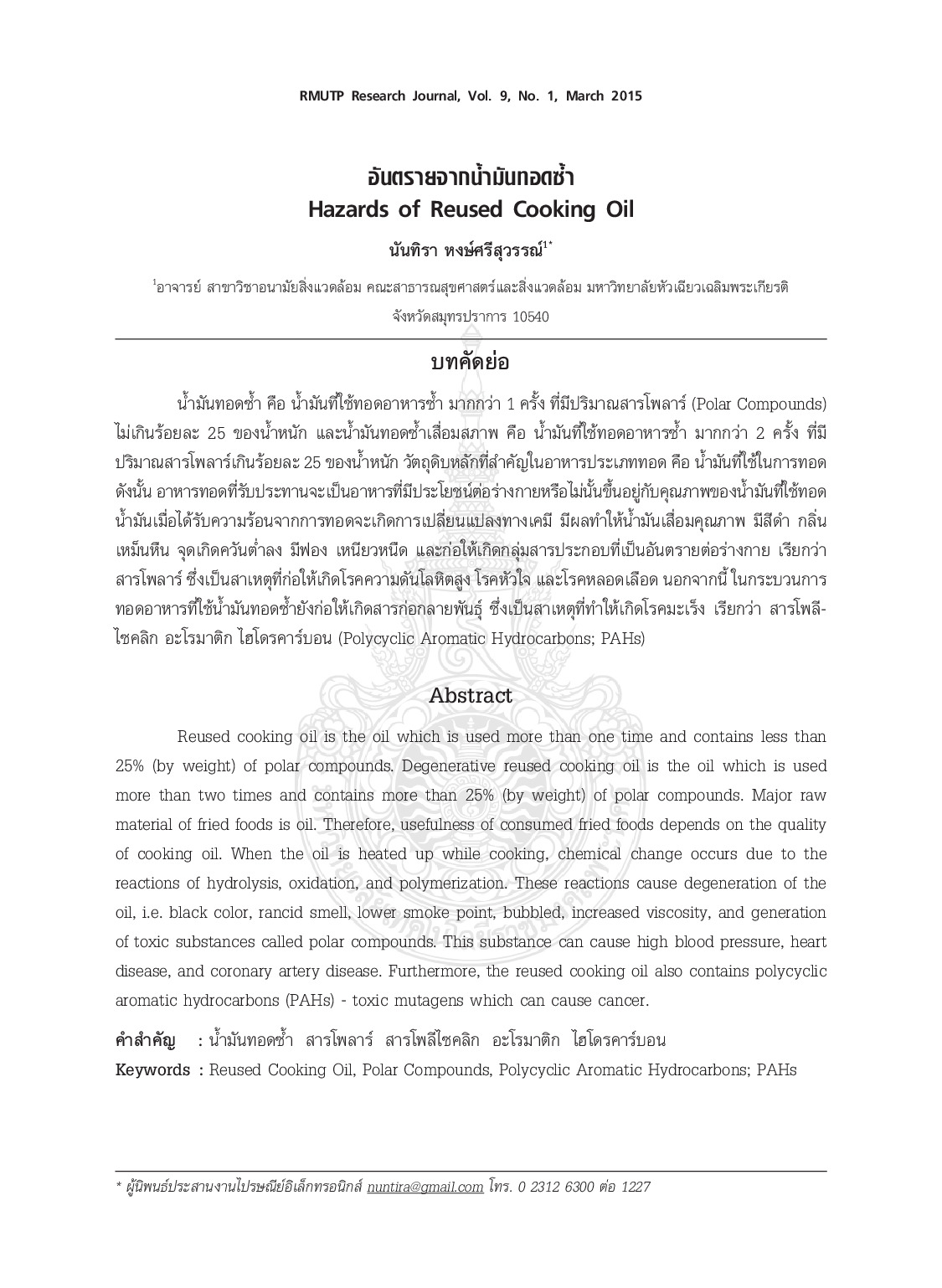
Hazards of reused cooking oil
Reused cooking oil is the oil which is used more than one time and contains less than 25% (by weight) of polar compounds. Degenerative reused cooking oil is the oil which is used more than two times and contains more than 25% (by weight) of polar compounds. Major raw material of fried foods is oil. Therefore usefulness of consumed fried foods depends on the quality of cooking oil. When the oil is heated up while cooking chemical change occurs due to the reactions of hydrolysis oxidation and polymerization. These reactions cause degeneration of the oil i.e. black color rancid smell lower smoke point bubbled increased viscosity and generation of toxic substances called polar compounds. This substance can cause high blood pressure heart disease and coronary artery disease. Furthermore the reused cooking oil also contains polycyclic aromatic hydrocarbons (PAHs) - toxic mutagens which can cause cancer.