จำนวน Repository ( 3611 )

Effect of binders on shrinkage cracking behavior of concrete
This research was aimed to study the effect of binders on cracking behavior of high strength concrete under restrained shrinkage condition. The cracking behaviors of concrete that study were cracking age in uniaxially restrained shrinkage test shrinkage rate free shrinkage crack propagation and strength of concrete. The binders used in this study were fly ash and limestone powder. The weight percentage of replacement of cement by fly ash and limestone powder were 30 and 10% respectively. The water to binder ratios was 0.35. The results indicated that the influence parameters of shrinkage cracking were type of binder amount of free shrinkage shrinkage rate and tensile creep of concrete. The use of fly ash and limestone powder could reduce free shrinkage and shrinkage rate of concrete and result in the longer cracking age than cement-only concrete. The tensile creep of cement-only concrete was higher than that of limestone powder concrete and fly ash concrete respectively
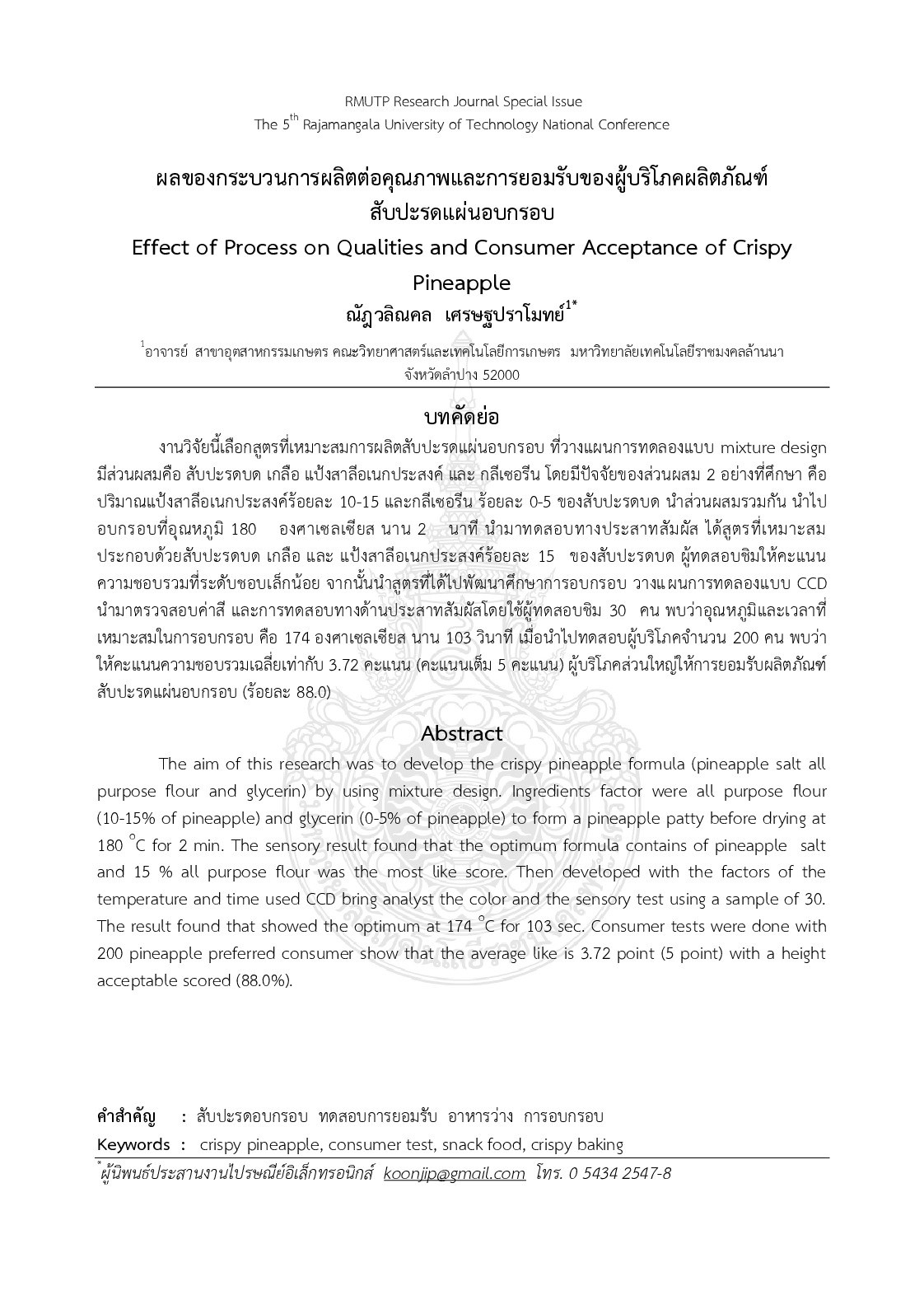
Effect of process on qualities and consumer acceptance of crispy pineapple
The aim of this research was to develop the crispy pineapple formula (pineapple salt all purpose flour and glycerin) by using mixture design. Ingredients factor were all purpose flour (10-15% of pineapple) and glycerin (0-5% of pineapple) to form a pineapple patty before drying at 180 oC for 2 min. The sensory result found that the optimum formula contains of pineapple salt and 15 % all purpose flour was the most like score. Then developed with the factors of the temperature and time used CCD bring analyst the color and the sensory test using a sample of 30. The result found that showed the optimum at 174 oC for 103 sec. Consumer tests were done with 200 pineapple preferred consumer show that the average like is 3.72 point (5 point) with a height acceptable scored (88.0%).
Influencing to make decision to buy green label product
The objective of this study was to study about consumers’ knowledge to green label an opinion and an effect to buy green label product. The subjects of this study were choser from the people who care with environment and lived in Bangkok. The instruments were Questionnaire. The data collected was statistically analyzed by percentage mean T-test Independent One Way ANOVA Chi-Square Spearman Rank Order Correlation Coefficient and LSD (Fisher’s Least Significant Different) The findings of this study revealed that : 1. The populations were more female than male. The most populations were 16-25 and the second one were 26-35. The first education level was bachelor degree and the second one was diploma. For an occupation the first was office workers and the second was students. 2. Involving in using green label products. 2.1 Using green label products which solving pollution. (1) Using gasohol. (2) Using non-mercury dry cells and paint. (3) Using non-CFC spray. (4) Using non-CFC refrigerator. 2.2 Using pr oducts which were not destroy water and economy. (1) Using non-phosphate detergent. (2) Using economic sanitary ware. (3) Using economic tap. (4) Using non washing Clothes. 2.3 Using products which reduce rubbish. (1) Using solar disintegrate bags. (2) Using refill products. (3) Using recycle plastic. 2.4 Using reduce destroying forest. (1) Using recycle tissue or paper. (2) Using recycle packages. 2.5 Using non-toxic products. (1) Using Non-toxic plants. (2) Using herbal products. (3) Using bio-fertilizer. 2.6 Using eco-energy. (1) Using eco-light bulb. (2) Using eco-refrigerator. (3) Using eco-air conditioner. (4) Using eco-electric fan. (5) Using eco-electric no. 5. 3. The population’ opinion about green label products’ mean was good. 4. The acknowledging about green label products revealed that the information media hadn’t enough. The first media which gave data the most was TV . The second was internet and newspaper. They wanted the government to fight more. The data which was important was telling about qualification and usefulness of the products and presented more about the products. For the contributing in the project or informing to someone revealed that they kindly to join the project. The populations’ understanding in green label products was moderate. The reason to buy the products was to protect environment and believe in quality and good for health. They wanted the government to pass the environmental law. 5. Hypothesis 5.1 The different sex and age had non-different opinion. 5.2 The different education had different opinion. The Graduate degree population had more knowledge in green label products more than the lower degree. 5.3 The different career had different opinion. The civil servant and the state enterprise employee and more knowledge in green label products more than the others. 5.4 The different type of media had non-different opinion. 5.5 The different type of media had an effect to buy the products. 5.6 The green products’ knowledge hadn’t an effect to buy the products. 5.7 The green label products’ knowledge hadn’t relate to the type of media.
Design and implementation of economical cost 30V 1 kW DC-electronic load controlled by microcontroller
Electronic load is an importance part of power supplies testing system. For non-electronic load type it is required to replace a resister with a new one leading to complicated working procedure. The modern power electronic technology is employ to solve this problem. The electronic load can vary the value following user command. Imported electronic load is costly leading Thailand to have a balance of trade deficit. This article proposes design and implement of an economical cost 30V 1 k DC-Electronic Load controlled by Microcontroller. The tested results can confirm the validity of this proposed electronic load
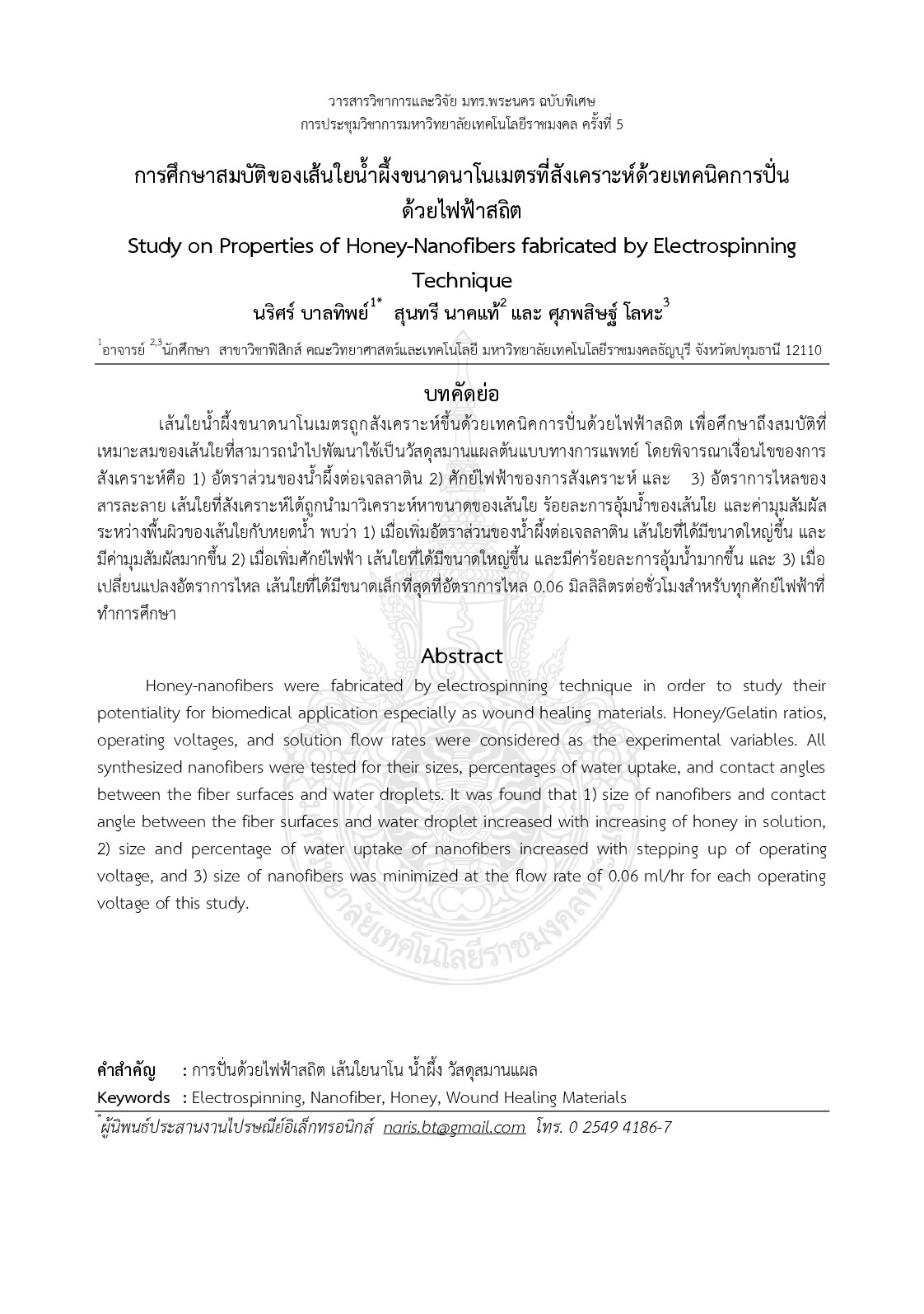
Study on properties of honey-nanofibers fabricated by electrospinning technique
Honey-nanofibers were fabricated by electrospinning technique in order to study their potentiality for biomedical application especially as wound healing materials. Honey/Gelatin ratios operating voltages and solution flow rates were considered as the experimental variables. All synthesized nanofibers were tested for their sizes percentages of water uptake and contact angles between the fiber surfaces and water droplets. It was found that 1) size of nanofibers and contact angle between the fiber surfaces and water droplet increased with increasing of honey in solution 2) size and percentage of water uptake of nanofibers increased with stepping up of operating voltage and 3) size of nanofibers was minimized at the flow rate of 0.06 ml/hr for each operating voltage of this study.