จำนวน Repository ( 3611 )

การปรับปรุงคุณภาพภาดฃพโดยวิธีการปรับเท่าฮีสดตแกรมออกเป็นสองส่วนผ่านทางเวฟเล็ต
The image enhancement process of a digital image is a part of digital signal processing which it plays an important role in some industrial segments for instance object classification or bio-identification satellite exploration or aerial images robot vision cancer treatment etc. These image applications are necessary to consume many resources in physical hardware and computer programming including the intelligent algorithm development of complexly advanced processing in order to enhance digital images – as well as be easy to analyse by humans. This research is aimed to present on Contrast Enhancement using Bi-Histogram Equalization via Two Dimensional Discrete Wavelet Transform (BHE2DWT) in order to compose the coefficient wavelet from other signals. At the end of the process information on the approximation band from DWT will be divided into two sub-histograms and then histograms will be independently equalized. After that resulting histograms will be decomposed by IDWT. Resulting images will be not only more displaying in high contrast than their original images but also preserve the absolute mean brightness error (AMBE) to close their original images.
The Development of multimedia and interactive system, through network for learning of opportunities school
This research focuses on development of Multimedia and Interactive System through Network for Learning of Opportunities School. This system used as a channel for students to learn outside the classroom and used as a teaching management tool for teacher. Tools for system development were program Microsoft Visual Studio. Database management system with MySQL. Write commands to work with PHP and Java scripts. For evaluating efficiency of the developed system this research used Sample group to answer questionnaires. The population of research is teachers and students of the Bankamwa school (Weboonratsamakee) in totals 97 people. The result of experiment shows that group is recognized the performance of system in the higher level and the system has efficiency of working.
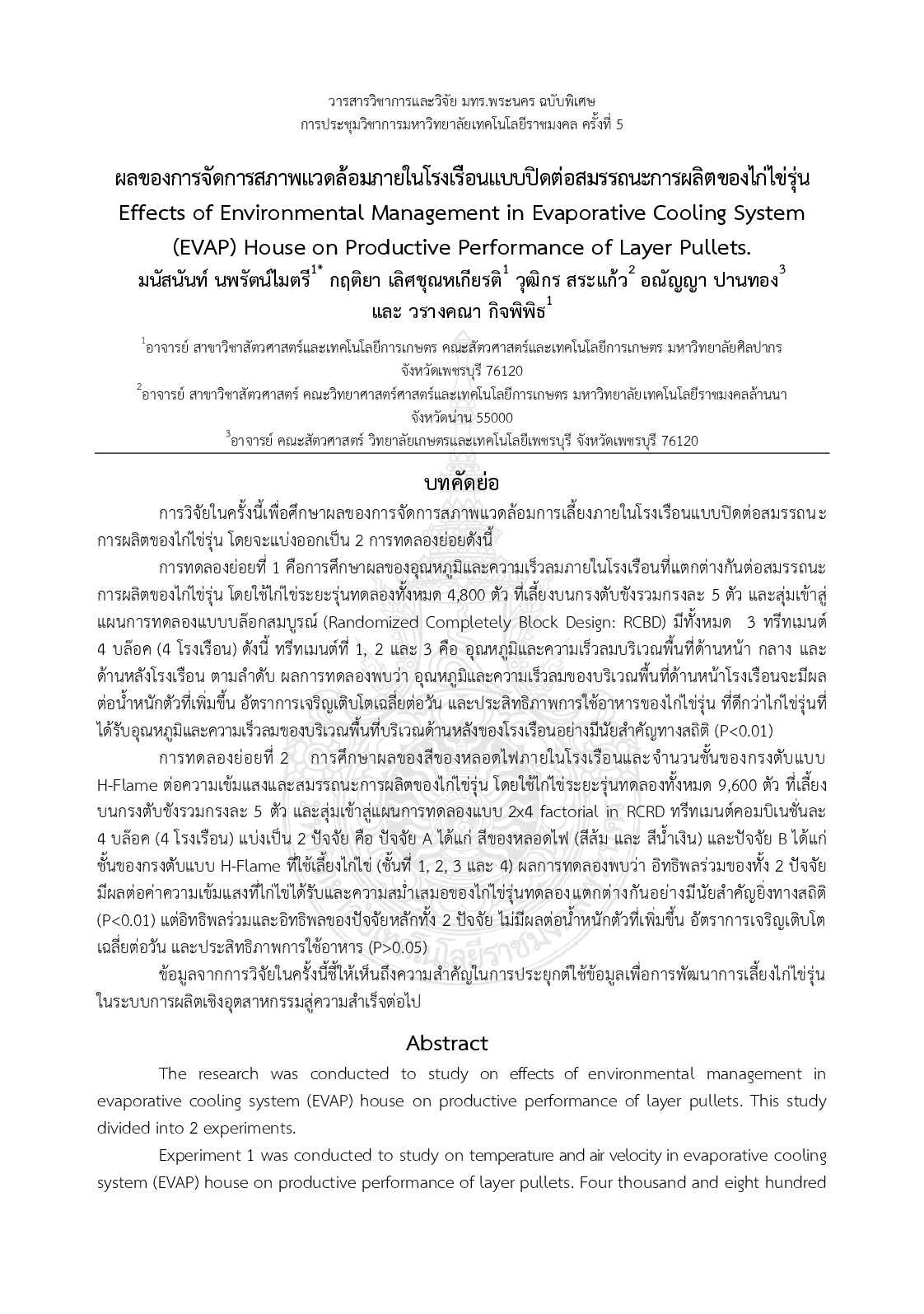
Effects of environmental management in evaporative cooling system (EVAP) house on productive performance of layer pullets
The research was conducted to study on effects of environmental management in evaporative cooling system (EVAP) house on productive performance of layer pullets. This study divided into 2 experiments. Experiment 1 was conducted to study on temperature and air velocity in evaporative cooling system (EVAP) house on productive performance of layer pullets. Four thousand and eight hundred layer pullets were raised on battery cage with 5 birds per cage and assigned in a Randomized Completely Block Design (RCBD) experiment with three treatments. Each treatment consisted of four blocks (four houses) and followed different temperature and air velocity in raising area of evaporative cooling system (EVAP) house as front area central area and back area. Results showed that temperature and air velocity in front area was grater body weight gain (BWG) average daily gain (ADG) and feed conversion ratio (FCR) of layer pullets than layer pullets were raised in back area of evaporative cooling system (EVAP) house (P<0.01) Experiment 2 was conducted to study on light color and number of H-Flame battery cage row in evaporative cooling system (EVAP) house on light intensity and productive performance of layer pullets. Nine thousand and six hundred layer pullets were raised on H-Flame battery cage with 5 birds per cage and assigned in a 2x4 factorial in Randomized Completely Block Design (RCBD) experiment with two factors. Factor A was light color comprised of range and blue). While Factor B was number of battery cage row comprised (first row second row third row and fourth row). Each treatment consisted of four blocks (four houses). Results showed that interaction between factor A and B on light intensity and uniformity of layer pullets with highly significantly different (P<0.01). However interaction between factor A and B and main effect (factor A and B) were investigated on body weight gain (BWG) average daily gain (ADG) and feed conversion ratio (FCR) (P>0.05). The data from this research was suggests the important for implicate to improve the egg production industry in further success.
System development consulting for quality assurance Rajamangala University of Technology Phra Nakhon
The purposes of the research was to develop the system consulting for quality assurance Rajamangala University of Technology Phra Nakhon including found out the quality by the experts and the system users’ satisfaction. The research tools were as follows: 1) the system consulting for quality assurance Rajamangala University of Technology Phra Nakhon 2) quality evaluation form and 3) a questionnaire on users’ satisfaction. Tool for system development of this research were Microsoft FrontPage and Macromedia Flash Version 8.0. The research sampling group consisted of 30 the administers and staffs educational from assurance departments. The results of this research was found that the quality evaluated by experts in content towards the system consulting for quality assurance Rajamangala University of Technology Phra Nakhon was as a good level the average mean was as 4.15 and the standard deviation was as 0.63 in order words. The quality evaluated by experts in multimedia was 4.16 on the average or at a good level and the standard deviation was as 0.41 in order words. The users’ satisfaction on the system consulting for quality assurance Rajamangala University of Technology Phra Nakhon was 3.97 on the average or at a good level and the standard deviation was as 0.06. Therefore the system consulting for quality assurance Rajamangala University of Technology Phra Nakhon was able to be used properly.
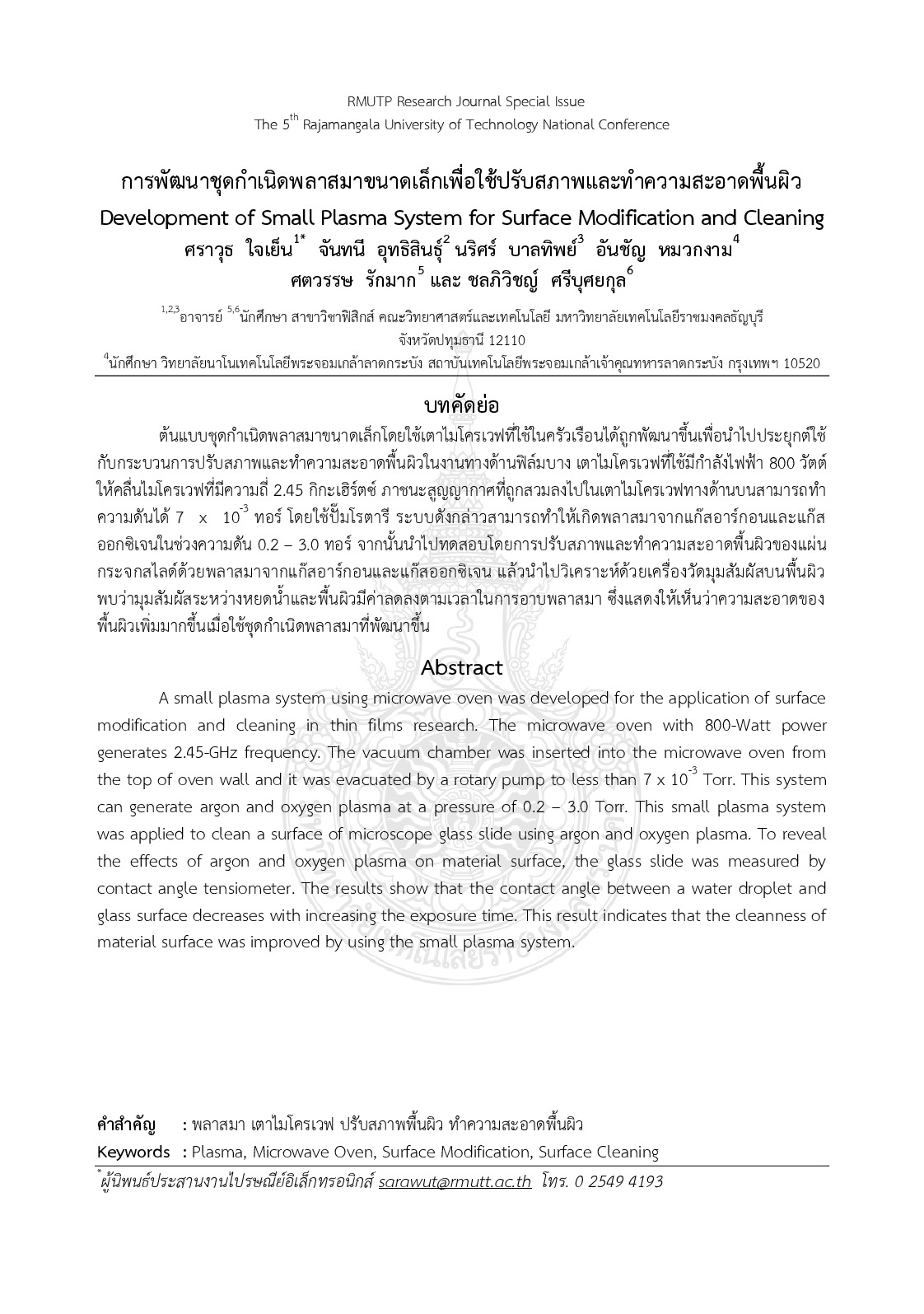
Development of small plasma system for surface modification and cleaning
A small plasma system using microwave oven was developed for the application of surface modification and cleaning in thin films research. The microwave oven with 800-Watt power generates 2.45-GHz frequency. The vacuum chamber was inserted into the microwave oven from the top of oven wall and it was evacuated by a rotary pump to less than 7 x 10⁻³ Torr. This system can generate argon and oxygen plasma at a pressure of 0.2 – 3.0 Torr. This small plasma system was applied to clean a surface of microscope glass slide using argon and oxygen plasma. To reveal the effects of argon and oxygen plasma on material surface the glass slide was measured by contact angle tensiometer. The results show that the contact angle between a water droplet and glass surface decreases with increasing the exposure time. This result indicates that the cleanness of material surface was improved by using the small plasma system.