จำนวน Repository ( 3611 )
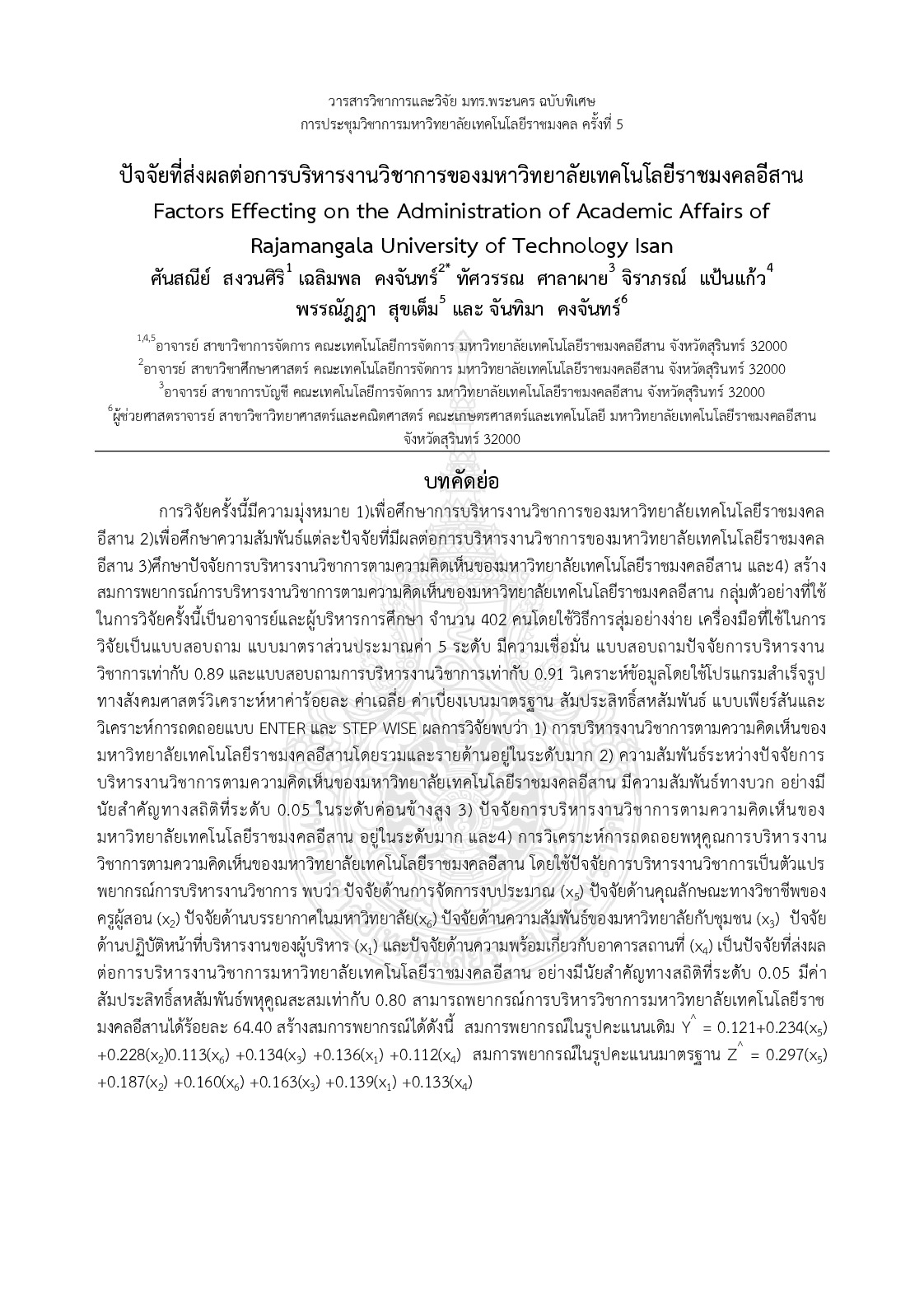
Factors effecting on the administration of academic affairs of Rajamangala University of Technology isan
The purposes of this research were 1) to study the school academic administration of Rajamangala University of Technology Isan 2) to study the correlation between the administrative factors of school academic administration and the university academic administration of Rajamangala University of Technology Isan 3) to study Factors Effecting on the Administration of Academic Affairs of Rajamangala University of Technology Isan 4) to analyze the multiple regression of Factors Effecting on the Administration of Academic Affairs of Rajamangala University of Technology Isan. The sample groups were Teachers and Administrator in Rajamangala University of Technology Isan. The sample groups were 402 Teachers and Administrators selected through Simple Sampling. The research instrument was a 5 level-rating scales questionnaire with the reliabilities of part 2 and 3 were 0.89 and 0.91 respectively. The statistical Techniques employed in data analysis were percentage mean standard deviation Pearson Product Moment Correlation Coefficient and Enter and stepwise Multiple Regression Analysis by using the Computer program. The results were as follows 1. A whole and each part of the University academic administration of Rajamangala University of Technology Isan were high level. 2. The positive relationship of the administrative factors and the school academic administration of Rajamangala University of Technology Isan were high level and significantly at 0.05 3. A whole factors and each part of the academic administration of Rajamangala University of Technology Isan were high level. 4. For the forecast of best factor Enter and stepwise Multiple Regression Analysis it was found that the budget management(x5) characteristics of teachers(x2) University atmosphere(x6) the relationship between University and community (x3) Performance of administrator(x1) and the readiness of University of administration at 0.05 level significance (x4). If showed a stepwise Multiple Regression (R) of 0.80 finally the forecast for the University academic administration was at 64.40 percent. The forecast equations for the University academic administration were as follows: Equation of raw score: Y^ = 0.121+0.234(x5) +0.228(x2)0.113(x6) +0.134(x3) +0.136(x1) +0.112(x4) Equation of standard score: Z^ = 0.297(x5) +0.187(x2) +0.160(x6) +0.163(x3) +0.139(x1) +0.133(x4)

Potential of extracts of Ficus hispida linn for controlling germination and Growth of Weed in Rice Field for Increase the value of biodiversity and its sustainable use
The potential of extracts of the Ficus hispida Linn to inhibit germination and growth of barnyardgrass (Echinochloa crus-galli) a common weed in rice. The bark leaves and fruit of F. hispida isolated by the Maceration and extracted by the polarity of the solvent (Sequential Extraction) with organic solvents such as hexane ethyl acetate and methanol when each part of the crude extract was tested the type of phytochemical tested for germinate inhibition root length inhibition stem length inhibition and dry weight inhibition of barnyardgrass and selected extracts with highest inhibition to separation using column chromatography the fractions tested repeating. The results showed that 1. Crude methanolic extracts from the bark leaves and fruit of barnyardgrass at a concentration of 3000 ppm showed highest inhibited percentage of germinate inhibition root length inhibition stem length inhibition and dry weight inhibition. 2. Fractions methanolic extracts from the bark leaves and fruit of barnyardgrass on a separate with column chromatography found that fractions extracts F5 F8 and F2 showed highest inhibited percentage of germinate inhibition root length inhibition stem length inhibition and dry weight inhibition.
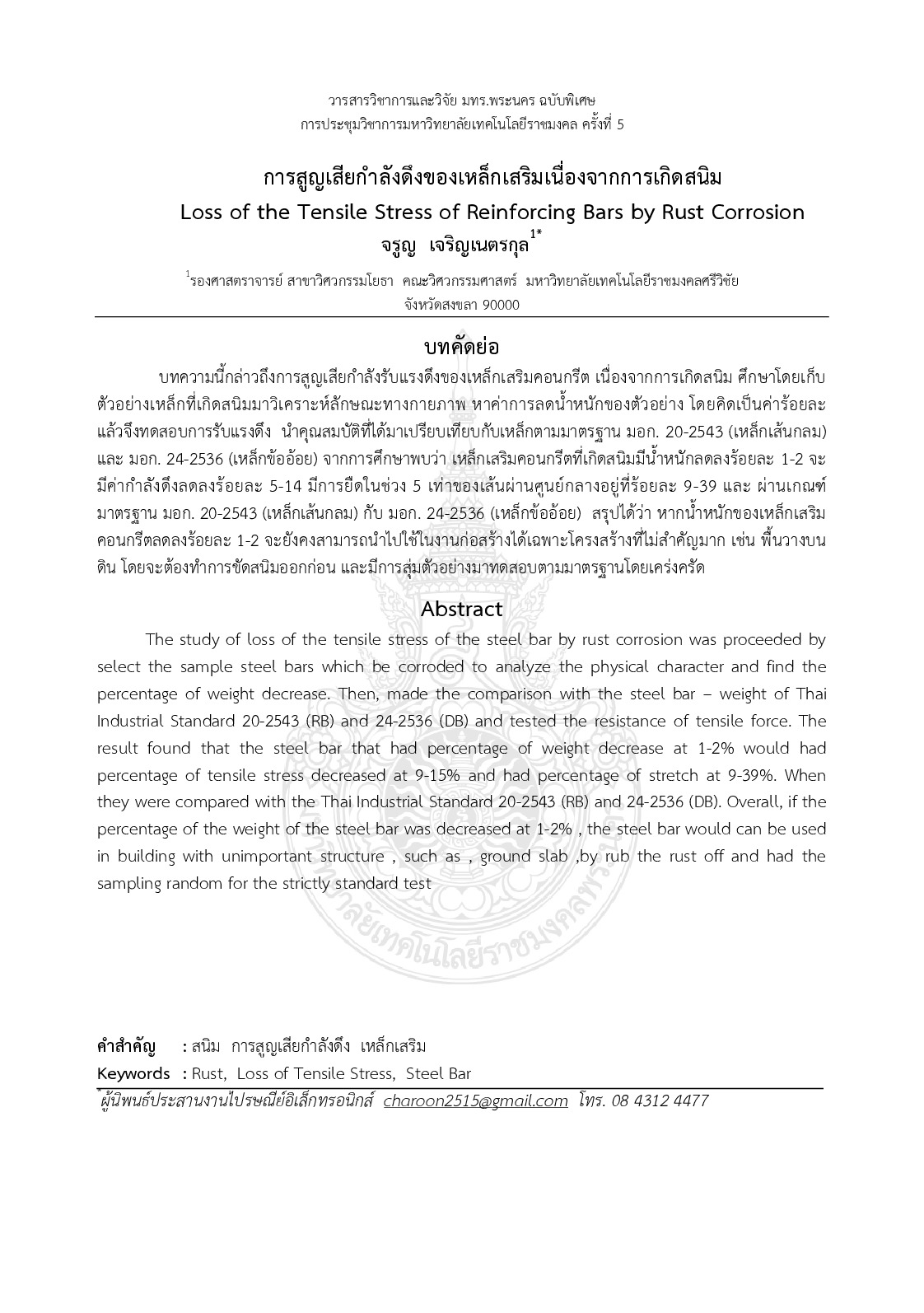
Loss of the tensile stress of reinforcing bars by rust corrosion
The study of loss of the tensile stress of the steel bar by rust corrosion was proceeded by select the sample steel bars which be corroded to analyze the physical character and find the percentage of weight decrease. Then made the comparison with the steel bar – weight of Thai Industrial Standard 20-2543 (RB) and 24-2536 (DB) and tested the resistance of tensile force. The result found that the steel bar that had percentage of weight decrease at 1-2% would had percentage of tensile stress decreased at 9-15% and had percentage of stretch at 9-39%. When they were compared with the Thai Industrial Standard 20-2543 (RB) and 24-2536 (DB). Overall if the percentage of the weight of the steel bar was decreased at 1-2% the steel bar would can be used in building with unimportant structure such as ground slab by rub the rust off and had the sampling random for the strictly standard test
The Mechanical strength of white rice kernel related to milling quality
The processes of rough rice milling for increase head rice yield are depending on several factors. The paddy rigidities are the one of these is effect to head rice yield. In the past research papers were showed that the qualities of milling were measuring from head rice yield and rigidities of rough rice were rerated to head rice yields. In this research aim to test the rigidities of the white rice with the bending test and showing the relation between white rice rigidities and head rice yield. The PTT1 RD41 RD31 and RD49 rice varieties were used in the experiment. The result showed that the high relation between the brown rice yield and head rice yield with determination coefficient was 0.81and the brown rice yield was heavy weight more than the head rice yield about 20%. The determination coefficient between the white rice rigidities and head rice yield was 0.16 showed that the less relation.
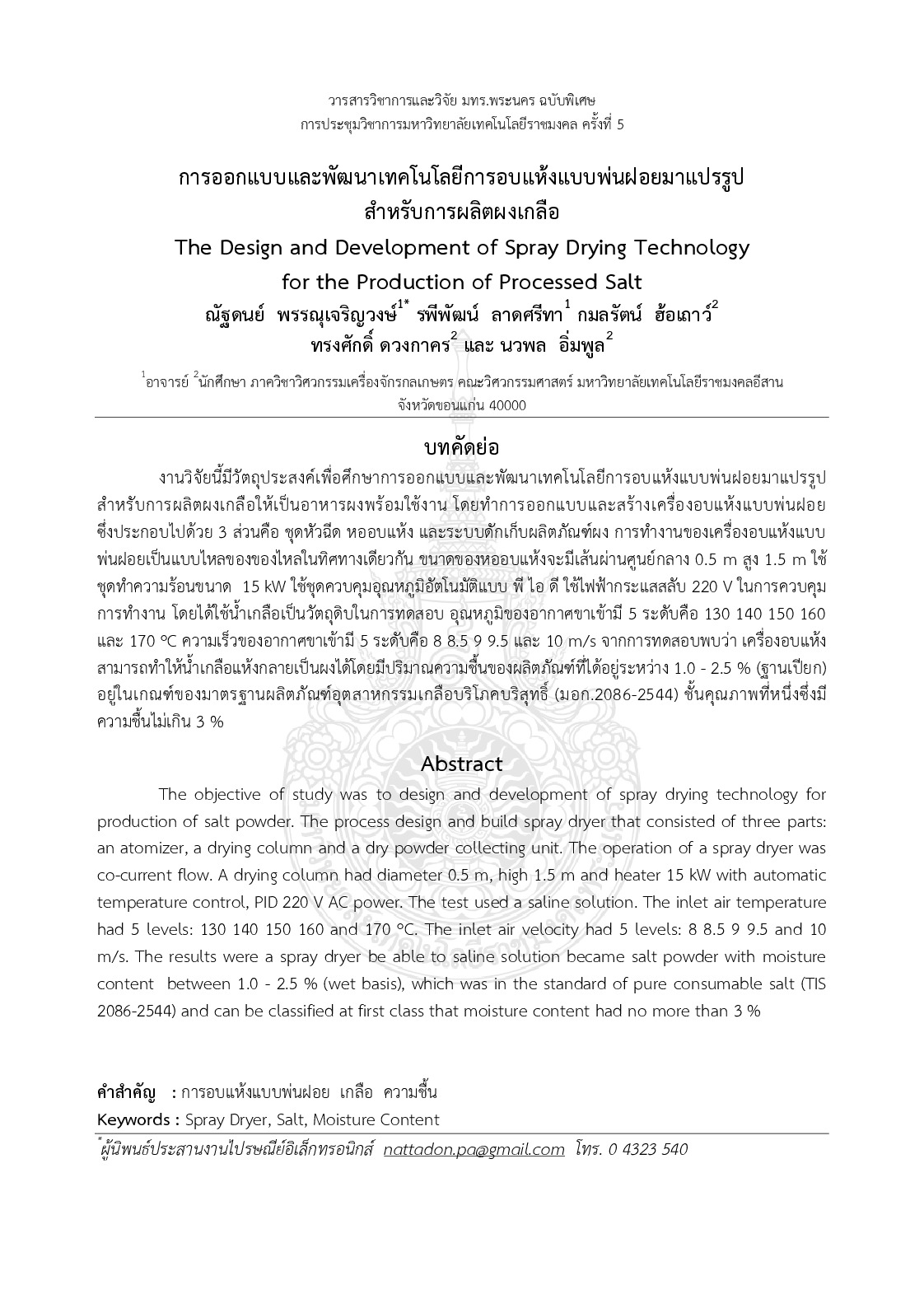
The design and development of spray drying technology for the production of processed salt
The objective of study was to design and development of spray drying technology for production of salt powder. The process design and build spray dryer that consisted of three parts: an atomizer a drying column and a dry powder collecting unit. The operation of a spray dryer was co-current flow. A drying column had diameter 0.5 m high 1.5 m and heater 15 kW with automatic temperature control PID 220 V AC power. The test used a saline solution. The inlet air temperature had 5 levels: 130 140 150 160 and 170 ?C. The inlet air velocity had 5 levels: 8 8.5 9 9.5 and 10 m/s. The results were a spray dryer be able to saline solution became salt powder with moisture content between 1.0 - 2.5 % (wet basis) which was in the standard of pure consumable salt (TIS 2086-2544) and can be classified at first class that moisture content had no more than 3 %